Register for Self Assessment as an Online Seller: the 5 October 2026 Deadline
August 27, 2026
Salary or dividends for ecommerce directors: the 2026/27 numbers
September 8, 2026
The Autumn Budget 2026 for online sellers comes down to one date: Wednesday 28 October 2026. Three things sit in front of it: a consultation on VAT for marketplace sales by UK businesses, a confirmed decision to remove customs duty relief on cheap imports, and dividend rates that are already set for this tax year. Two are settled policy, one is only proposed.
Every autumn brings a wave of speculation about what the Chancellor might do, and most of it is worthless to a seller trying to plan. This guide leaves the guesswork out. It covers what has actually been announced or consulted on, what is already locked in for 2026/27, and the handful of things worth checking in your own accounts before the speech.
- When the Autumn Budget 2026 happens, and why the date matters
- Marketplace VAT liability is the reform most likely to change your payouts
- Cheap imports: the £135 customs duty relief is going
- Where the numbers stand today, before the Chancellor speaks
- Your pre-Budget checklist: Autumn Budget 2026 for online sellers
- What to do in the week after the Budget
- Frequently asked questions
When the Autumn Budget 2026 happens, and why the date matters
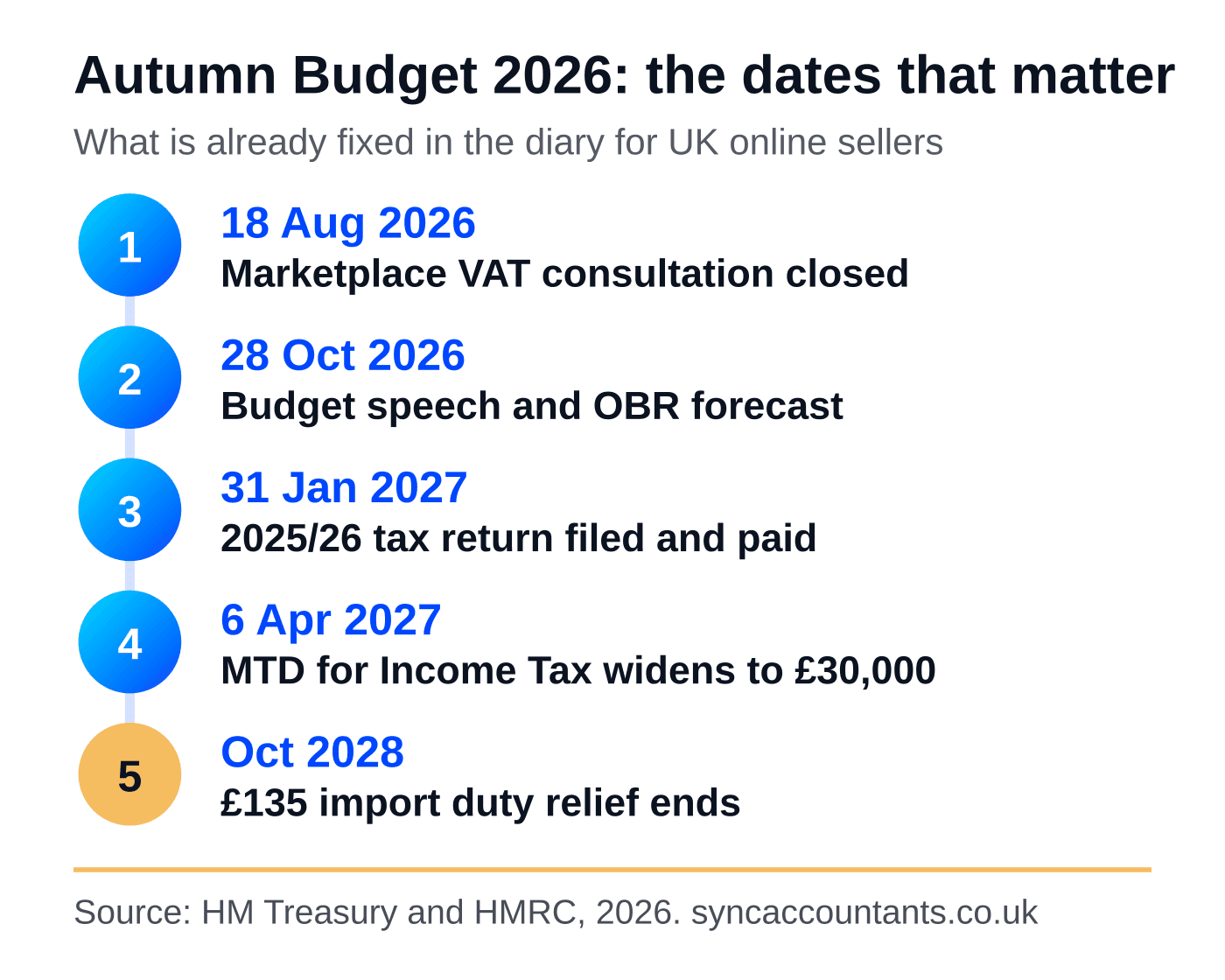
The Chancellor, Rt Hon John Healey MP, confirmed the date in a letter to the Treasury Select Committee: Wednesday 28 October 2026, with an Office for Budget Responsibility economic and fiscal forecast published alongside it.
That timing matters for a seasonal business. It lands roughly four weeks before Black Friday, in the middle of the quarter when most online retailers commit to stock, ad spend and seasonal staff. Decisions you make in September and early October are already made by the time the Chancellor stands up.
The practical consequence is that you should not wait for the speech to plan Q4. What a Budget can realistically change in the next few weeks is narrow, because most rate changes take effect from the start of a tax year rather than the day of the announcement. What it can change is your 2027 planning, and that is where the attention belongs.

Marketplace VAT liability is the reform most likely to change your payouts
This is the one to read properly. HMRC and HM Treasury ran a joint consultation from 23 June to 18 August 2026 on extending VAT online marketplace liability. Today those rules apply mainly to overseas sellers. The proposal would extend them to UK businesses selling to consumers where the goods are in the UK at the point of sale.
The mechanism the consultation put forward, and it is a proposal rather than a decision, would change the plumbing for a VAT-registered UK seller rather than the total tax. Your sale would become a zero-rated supply to the marketplace, and the marketplace would charge the VAT and account for it on its own return. You would stop declaring output VAT on those sales, while still recovering input tax on your costs and still accounting for VAT normally on your own website.
Sellers below the £90,000 VAT registration threshold are the group with most at stake, because a blunt version of this rule would put VAT on their marketplace prices for the first time. The consultation put two mitigations on the table: a minimum platform threshold, so a marketplace is only liable once a seller passes a set value of sales on that platform, possibly £90,000 or lower, or a relief for businesses under the registration threshold.

No decision has been published and no start date has been set. The consultation says responses will be considered before anything is confirmed, and that a technical consultation would follow if the government proceeds. The Budget is the next fiscal event at which a response could come, though the government has not committed to responding then. If you already sell across several channels, our note on marketplace VAT for UK sellers explains how the current rules split responsibility between you and the platform.
Cheap imports: the £135 customs duty relief is going
Goods imported in consignments worth £135 or less can currently come in free of customs duty, where the relief is available. That relief is being removed. It was announced at Autumn Budget 2025, and in June 2026 the government accelerated the timetable by six months. The commencement date will be appointed by Treasury regulations, by October 2028 at the latest, so the decision is firm while the exact day is not yet set.
Two things are worth separating here. VAT is already charged on these consignments, normally by the seller or the marketplace at the point of sale under the special rules for low value imports, so this is not a new tax on imports in general. What changes is customs duty, which is charged by commodity code and origin, and which varies far more between product lines than VAT does. A seller importing textiles and a seller importing electronics will feel very different effects.
October 2028 sounds distant, and it is not a reason to act today. It is a reason to know your commodity codes and your landed cost per unit now, because that is the work that takes months rather than weeks. If you source from overseas suppliers, our guide to how Budget decisions affect cheap imports covers the same ground from the buying side.
Need this done for you? Our FCCA-chartered team handles VAT, import costs and profit extraction for UK ecommerce sellers every day. Book a free 30-minute call and we’ll show you what we’d do in the first 30 days.
Where the numbers stand today, before the Chancellor speaks
Plenty of the numbers people expect the Budget to move are already set. Working from these figures is more useful than working from a forecast, provided you remember that announced future phases can still be amended by a later Budget.
| What | Current law and announced policy at 3 September 2026 |
|---|---|
| VAT registration threshold | £90,000 of taxable turnover, on a rolling 12 months or expected in the next 30 days |
| Dividend allowance | £500 |
| Dividend rates from 6 April 2026 | 10.75% basic, 35.75% higher, 39.35% additional. UK-wide |
| Personal Allowance and higher rate threshold | £12,570 and £50,270, held until 5 April 2031. The threshold applies to England, Wales and Northern Ireland, and the allowance tapers above £100,000 |
| Making Tax Digital for Income Tax | Live since April 2026 at £50,000 qualifying income. £30,000 from April 2027, £20,000 from April 2028 |
| Low value import duty relief | £135 relief still applies today. Removal by October 2028 at the latest |
Three of those need a second look. The frozen Personal Allowance and the £50,270 higher rate threshold mean a growing store pushes its owner into higher-rate territory without any rate ever changing, which is exactly the point at which the salary and dividend split stops being obvious. Scottish taxpayers have their own rates and bands on salary, so the £50,270 figure does not govern that side of the calculation for them, though the dividend rates for 2026/27 are UK-wide.
Dividend timing is worth getting right. The rate depends on which tax year the dividend falls into, and the boundary is 6 April, so a dividend in March and one in April usually sit in different years at different rates. The date that counts is not the date of the board minute: a final dividend is generally taxed when it becomes due and payable, and an interim one when it is actually paid or made available to the shareholder.
If you trade from premises in England, check which business rates multiplier your property is on. From 2026/27 England has lower multipliers for qualifying retail, hospitality and leisure properties with a rateable value under £500,000, and a higher one for properties at £500,000 and above. Storage and distribution units are not generally treated as retail, so a fulfilment centre should not be assumed to qualify. Scotland, Wales and Northern Ireland run their own non-domestic rating systems.
Your pre-Budget checklist: Autumn Budget 2026 for online sellers
Five things, all of which are worth doing whether or not the Budget touches them.
- Split your turnover by channel. If marketplace VAT liability moves, the change only touches marketplace sales with goods in the UK. Knowing what share of your revenue that is turns a policy question into a number.
- Check your taxable turnover against £90,000. There are two tests: the rolling 12-month figure, and whether you expect to pass £90,000 in the next 30 days alone. A strong Q4 is the usual reason a seller trips either one without noticing, and neither depends on your year end.
- Pull your commodity codes and landed costs together. One line per SKU, with the duty rate and origin. This is the file you will want when the low value import rules land.
- Model your profit extraction on the 2026/27 rates. Use £500 of dividend allowance, 10.75% and 35.75%, and the frozen £50,270 threshold, not last year’s assumptions.
- Check your Making Tax Digital start date. This applies to sole traders and landlords, not to limited-company turnover, and qualifying income means gross self-employment and property income before expenses. Over £50,000 and you are already in. Over £30,000 for 2025/26 and you join from April 2027, set by your 2025/26 return. Some exemptions apply, so check yours.
What to do in the week after the Budget
Read the measure, not the headline. Every Budget announcement comes with its own commencement date, and for a seller that date is usually more important than the rate itself. A duty change that starts in 2028 and a VAT change that starts next April call for completely different responses.
Then check three things in order. Whether anything alters VAT on your marketplace sales, whether your import duty position changes, and whether the rates on salary, dividends or National Insurance move for 2027/28. If all three are unchanged, the Budget was a news event rather than a business event, and that is a perfectly common outcome.
If something does move, the sequence matters. Pricing and cash flow first, because they affect Q4 trading. Profit extraction second, because you usually have until the tax year end. Software and record keeping third, alongside your Making Tax Digital quarterly updates, which run to their own timetable regardless.
Frequently asked questions
When is the Autumn Budget 2026?
Wednesday 28 October 2026. The Chancellor confirmed the date in a letter to the Treasury Select Committee, and the Office for Budget Responsibility publishes its economic and fiscal forecast on the same day.
Do Budget tax changes apply straight away?
It depends on the measure. Some duty changes take effect within hours of the speech, while income tax and dividend rate changes normally start at the beginning of a tax year. Every announcement states its own commencement date, so check that before acting.
Will online marketplaces start collecting VAT for UK sellers?
It is proposed, not decided. HMRC and HM Treasury consulted on extending online marketplace VAT liability to UK businesses between 23 June and 18 August 2026. No decision or start date has been published, and the Budget is the next fiscal event at which the government could respond.
What is happening to the £135 import rule?
Customs duty relief on consignments of £135 or less is being removed, six months earlier than first announced, with commencement set by Treasury regulations by October 2028 at the latest. VAT is already charged on these consignments at the point of sale, so the change is to customs duty, which varies by commodity code and origin.
Could the Budget change the VAT registration threshold?
It could, and it has been changed at past Budgets. For now the threshold is £90,000 of taxable turnover measured on a rolling 12 months. If it moves, the announcement will carry its own start date, so keep monitoring your rolling turnover in the meantime.
Talk to a UK ecommerce accountant
If you’d like a hand applying any of this to your business, our FCCA-chartered team works with over 700 UK ecommerce sellers across Amazon, Shopify, eBay and TikTok Shop. Tell us about your store and we’ll show you exactly what we’d do. Book a free consultation, see our ecommerce accounting services or request a tailored quote.