Autumn Budget 2026 for online sellers: what to check before 28 October
September 3, 2026
Companies House identity verification deadline: it is your confirmation statement, not 18 November
September 17, 2026
Salary or dividends for ecommerce directors in 2026/27 usually lands on a small salary plus dividends, because dividends carry no National Insurance. Dividend tax rose two points on 6 April 2026, so the gap narrowed. On £55,000 of company profit, a £12,570 salary still beats the next-best alternative by roughly £360 a year.
Most limited-company sellers set their pay once, when the company was formed, and never look at it again. The rates have moved since then, twice. This guide walks through the 2026/27 figures, puts three realistic splits side by side on the same profit, and shows the four situations where the usual answer stops being right.
- What changed for dividends on 6 April 2026
- The 2026/27 rates behind the decision
- Salary or dividends for ecommerce directors: £55,000 of profit, three ways
- Four things that change the numbers
- Profit on paper, stock in the warehouse
- What makes a dividend legal
- Frequently asked questions
What changed for dividends on 6 April 2026
Dividend tax went up. The basic rate moved from 8.75% to 10.75% and the higher rate from 33.75% to 35.75%, both from the start of this tax year. The additional rate stayed at 39.35% and the dividend allowance stayed at £500, where it has been since April 2024.
Two points sounds small. On the split we work through below it costs about £660 a year, for taking exactly the same money out of exactly the same company. Nothing about your business changed; the bill did.
What did not change is the reason the split exists in the first place. Salary is subject to National Insurance on both sides, employee and employer. Dividends are not subject to National Insurance at all. That gap is still wide enough that dividends win on the marginal pound for most director-shareholders, even after the increase.

The 2026/27 rates behind the decision
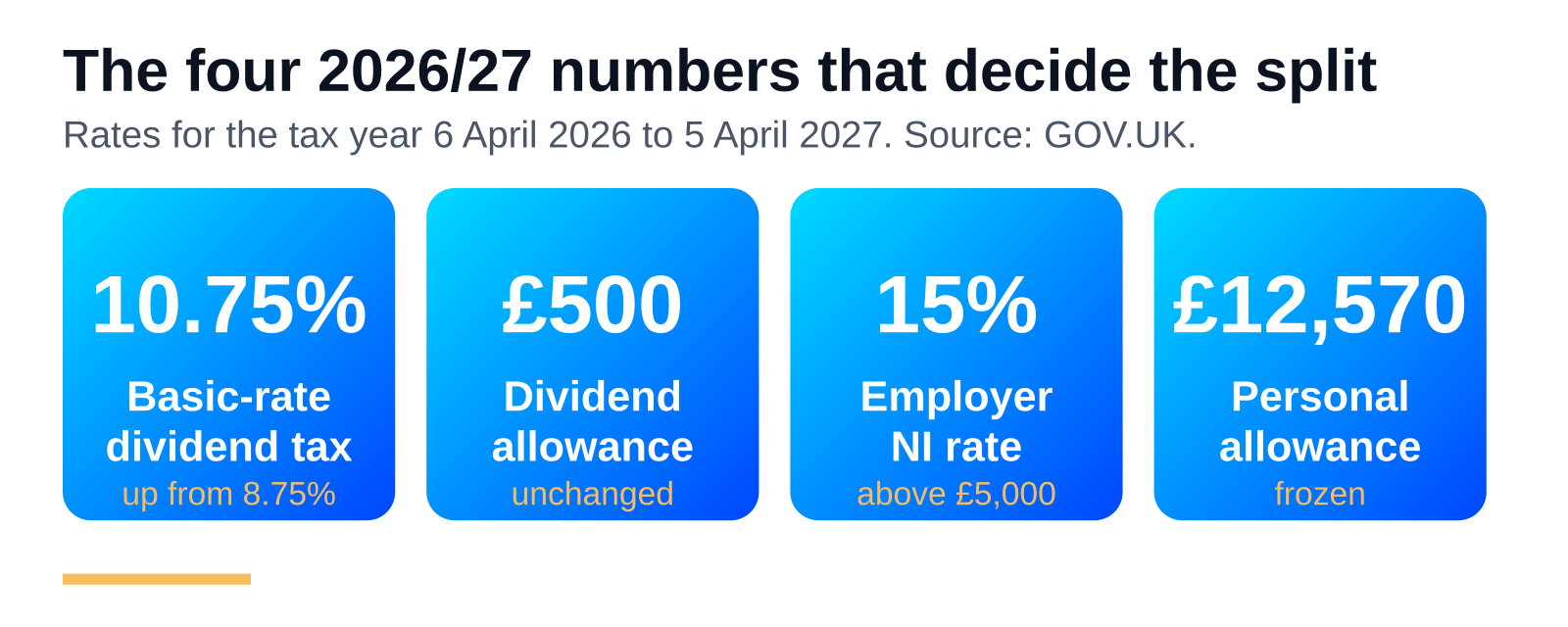
Four figures do most of the work, and a fifth decides whether the whole calculation shifts.
| What | 2026/27 |
|---|---|
| Personal allowance | £12,570, frozen. Tapers away above £100,000 of adjusted net income |
| Basic rate band ends | £50,270 of total income |
| Dividend allowance | £500 |
| Dividend rates | 10.75% basic, 35.75% higher, 39.35% additional. UK-wide |
| Employee National Insurance | 8% on salary above £12,570, 2% above the upper earnings limit |
| Employer National Insurance | 15% on salary above the £5,000 secondary threshold |
| Lower earnings limit | £6,708. The point at which a salary starts building state pension entitlement |
| Employment Allowance | £10,500, but not available to most one-director companies |
| Corporation tax | 19% up to £50,000 of profit, 25% above £250,000, marginal relief between |
The Employment Allowance is the one that catches people. It knocks £10,500 off an employer’s National Insurance bill, which would wipe out the employer cost of a director’s salary entirely. But the eligibility rules are explicit: “If your company has only one director, they must not be the only employee liable for secondary Class 1 National Insurance.” A single director drawing the only meaningful salary in the company cannot claim it. A company with a second employee paid above £5,000 usually can.
One scope note before the numbers. The salary side of this uses the income tax bands for England, Wales and Northern Ireland. Scottish taxpayers have their own rates and bands on employment income, so the £50,270 figure does not govern that half of the calculation for them. The dividend rates are UK-wide.
Salary or dividends for ecommerce directors: £55,000 of profit, three ways
Take a realistic case. A single-director ecommerce company, no other employees, £55,000 of profit before the director is paid anything, and the director has no other income. Everything left after salary and corporation tax comes out as dividends. Corporation tax stays at 19% in all three versions because profit after the salary deduction does not exceed £50,000. That assumes no associated companies: a director who also controls a second company halves the £50,000 limit, which would put all three columns into the 26.5% marginal band and change the answer.
| Salary £5,000 | Salary £6,708 | Salary £12,570 | |
|---|---|---|---|
| Employer National Insurance | £0 | £256 | £1,136 |
| Corporation tax at 19% | £9,500 | £9,127 | £7,846 |
| Dividend available | £40,500 | £38,909 | £33,449 |
| Dividend tax at 10.75% | £3,486 | £3,499 | £3,542 |
| Total tax and NI | £12,986 | £12,882 | £12,523 |
| In the director’s hands | £42,014 | £42,118 | £42,477 |
Every cell is rounded to the nearest pound, so a column can read £1 out against its own total. The underlying figures are exact, and total tax in the third column is £12,523.42.
The £12,570 salary wins, by about £360 over the lower earnings limit option and about £460 over a £5,000 salary. That is despite it carrying £1,136 of employer National Insurance, which the other two largely avoid.
The reason is that salary and the employer National Insurance on it are both deductible against corporation tax. Paying £12,570 as salary rather than leaving it in the company to be distributed removes £13,706 from taxable profit, saving £2,604 of corporation tax, and the salary itself lands inside the personal allowance where it is taxed at nothing. Employer National Insurance at 15% costs less than the corporation tax and dividend tax saved.
Note the £5,000 option specifically. It attracts no employer National Insurance at all, which is why it gets recommended, and it is the worst of the three here. It also sits below the £6,708 lower earnings limit, so it does not build a qualifying year towards the state pension. You would be paying more tax for a worse pension record.
Need this done for you? Our FCCA-chartered team sets the salary and dividend split for UK ecommerce sellers every day, and reviews it whenever the rates move. Book a free 30-minute call and we’ll show you what we’d do in the first 30 days.
Four things that change the numbers
Salary or dividends for ecommerce directors is not one answer applied to everyone. Four things move it, and the first is the one we correct most often.
You have a job or other income already
This is the big one, and it is common among sellers who started the shop alongside employment. If a salaried job already uses your personal allowance, a company salary on top is taxed at 20% income tax under a BR code. Employee National Insurance is assessed separately for each employment, so a company salary up to £12,570 still attracts none of that. Employer National Insurance at 15% does apply, but only above the £5,000 secondary threshold. The comparisons below assume your total income stays inside the basic rate band.
That threshold splits the answer in two. The first £5,000 of salary carries no employer National Insurance at all, so £1 of company profit spent on it returns 80p to you, against 72p for the same pound taken as a dividend after 19% corporation tax. Take that £5,000. The slice between £5,000 and £12,570 does carry employer National Insurance and returns about 70p, so at 19% corporation tax dividends just edge it.
That last part reverses once profits pass £50,000. In the £50,000 to £250,000 band every deductible pound of salary saves 26.5%, which drops the dividend route to about 66p and puts both salary slices ahead, so keep the full £12,570. Your day job is already covering the state pension year either way, assuming it pays above £6,708, so the lower earnings limit stops governing the floor here.
Your total income crosses £50,270
Above that point dividends are taxed at 35.75% rather than 10.75%. In the example above, total income lands at £46,019, leaving about £4,250 of headroom. A director who needs more than that should know the next slice costs more than three times as much, and that the frozen thresholds mean a growing store reaches this line without any rate changing. Splitting drawings across two tax years, or leaving profit in the company, is often worth more than any tinkering with the salary figure.
You have a second employee
If someone else in the company is paid above £5,000, the Employment Allowance usually becomes available and the £1,136 of employer National Insurance on a £12,570 salary disappears. Taking the same £55,000 of profit, measured after that employee has been paid, the director keeps roughly £43,300. That is about £820 better than the best of the three options above.
The salary has to be commercially justified for work actually done, though. Putting a spouse on the payroll at £5,001 to unlock the allowance is not a plan, it is a deduction HMRC can disallow.
Company profits are above £50,000
Between £50,000 and £250,000 marginal relief means the effective corporation tax rate on the next pound of profit is 26.5%, not 19%. Every deductible pound of salary is worth more, so the case for using the full personal allowance gets stronger, not weaker. Employer pension contributions are worth a look at this level too: they are deductible for the company and attract no National Insurance on either side.
Profit on paper, stock in the warehouse
Here is the part that is specific to selling online, and it is where we see the most damage. A dividend can only be paid out of accumulated realised profit. Not out of the bank balance. For a stock-holding ecommerce business those two numbers are rarely close, and in the fourth quarter they diverge hard.
The pattern runs like this. You buy stock in September and October for the Christmas run. Cash leaves. Sales land in November and December, but the marketplace holds the payout for a couple of weeks, so the bank looks healthy in January while a VAT quarter and a supplier invoice are both still to come. The balance sitting there is not profit. Some of it is HMRC’s and some of it is your supplier’s.
Set the dividend off the management accounts, not the bank app, and take it after the VAT and corporation tax provisions are in the numbers. If you want the fuller version of that exercise, our guide to cash flow forecasting for Black Friday covers the timing side properly.
What makes a dividend legal
Three things, and they take about ten minutes a quarter. There must be enough distributable profit to cover it, evidenced by accounts. There must be a board minute recording the decision. There must be a dividend voucher for each shareholder, showing the date, the company, the shareholder and the amount. Dividends also have to follow shareholdings, so a 50/50 shareholding cannot pay 70/30 without a proper alphabet share structure behind it.
Skip the paperwork and the money is not a dividend. It is a loan from the company to you, and if it is still outstanding nine months and one day after your year end the company pays a section 455 charge. The legislation sets that charge at the dividend upper rate for the tax year the loan was made, so a loan made on or after 6 April 2026 is charged at 35.75% and one made before that at 33.75%. HMRC’s summary guidance still shows the older figure, so go by the date of the loan. The tax comes back once the loan is repaid, but not promptly: relief is given nine months and one day after the end of the accounting period in which the repayment falls, so the cash can be out of the business for well over a year. It is a familiar find during a year-end review.
Salary has its own admin. It has to run through PAYE with real time information filings, even at £12,570 where no income tax or employee National Insurance is due. If you are still weighing the structure itself rather than the split, our comparison of sole trader against limited company for ecommerce is the better place to start, and choosing the right entity for an ecommerce business goes deeper on the trade-offs.
One date to keep in view. The Autumn Budget on 28 October 2026 could move dividend rates, National Insurance thresholds or corporation tax. Dividend rates have now risen twice in five years. If you are planning drawings for the rest of the tax year, treat the figures here as correct today and worth rechecking on 29 October.
Frequently asked questions
Is it better to take salary or dividends in 2026/27?
For most director-shareholders, a mix. A salary up to the £12,570 personal allowance is deductible for the company and taxed at nothing personally, then dividends carry no National Insurance. On £55,000 of company profit that combination leaves about £360 more in your hands than a lower salary. It changes if you have other income.
What is the optimum director salary for 2026/27?
£12,570 for a typical single-director company with no other income, even though it triggers £1,136 of employer National Insurance. £6,708 is the lowest salary that still builds a qualifying year towards the state pension. £5,000 avoids employer National Insurance but costs more overall and earns no pension credit.
Do I pay National Insurance on dividends?
No. Dividends are not subject to National Insurance on either side, employee or employer. That is the main reason the salary and dividend split exists. You do pay dividend tax, at 10.75% within the basic rate band in 2026/27, after the £500 dividend allowance.
Can I take a dividend if my company has no cash?
A dividend needs distributable profit, which is not the same as money in the bank. A stock-heavy ecommerce company often has one without the other. If there is no distributable profit the payment is a director’s loan, and the company faces a section 455 charge if it is unpaid nine months and one day after the year end. That charge follows the dividend upper rate for the year the loan was made, so 35.75% for a loan made in 2026/27.
Did dividend tax go up in April 2026?
Yes. From 6 April 2026 the basic rate rose from 8.75% to 10.75% and the higher rate from 33.75% to 35.75%. The additional rate stayed at 39.35% and the dividend allowance stayed at £500. On a typical basic-rate split that is roughly £660 a year more tax for the same drawings.
Talk to a UK ecommerce accountant
If you’d like a hand applying any of this to your business, our FCCA-chartered team works with over 700 UK ecommerce sellers across Amazon, Shopify, eBay and TikTok Shop. We set the split, run the payroll and keep the paperwork behind the dividends in order. See how our accountants for ecommerce work, then tell us about your store and we’ll show you exactly what we’d do. Book a free consultation or request a tailored quote.