MTD for Income Tax: prepare for the second quarterly update on 7 November
August 18, 2026
Autumn Budget 2026 for online sellers: what to check before 28 October
September 3, 2026
If you need to register for Self Assessment as an online seller, HMRC must hear from you by 5 October 2026. That applies to anyone whose gross trading income from selling online went over £1,000 during the 2025/26 tax year, which ran from 6 April 2025 to 5 April 2026. Registering is a separate step from filing.
Selling on eBay, Vinted, Etsy, Amazon or TikTok Shop can turn from a bit of extra money into a taxable trade faster than most people expect. If that happened to you during 2025/26, HMRC needs to know before 5 October. This guide covers who is caught, what the £1,000 allowance actually does, how to register, and what to do if the date has already gone.
- Who must register for Self Assessment as an online seller
- The £1,000 trading allowance, and what it does not do
- Being reported by a platform is not the same as owing tax
- How to register for Self Assessment before 5 October 2026
- What happens if you miss the 5 October deadline
- Why your 2025/26 return sets your Making Tax Digital start date
- Frequently asked questions
Who must register for Self Assessment as an online seller
The test is gross trading income above £1,000 in the tax year that ran from 6 April 2025 to 5 April 2026. Gross means the money before platform fees, postage and the cost of your stock. A seller who took £4,200 through Etsy and spent £3,000 on materials and fees is well over the line, even though the profit was only £1,200.
That test is about trading, not about clearing out your loft. Selling your own used clothes or furniture for less than you paid is not trading and is not taxed. Buying stock to resell, making things to sell, or flipping items for profit is trading, and the £1,000 test applies from the first pound of it.
Two things catch sellers out regularly. Income from different platforms is added together, so £600 on Vinted and £700 on eBay is £1,300 of trading income, not two amounts safely under the limit. And if you already file a return for another reason, your selling income belongs on that same return regardless of how small it is.
The £1,000 trading allowance, and what it does not do
The trading allowance is £1,000 of gross trading income a year that you do not pay tax on. Stay under it and, in most cases, there is nothing to report. Go over it and you have a choice: deduct the £1,000 allowance from your gross income, or deduct your actual business expenses. You cannot do both.
For a seller carrying real stock costs, actual expenses almost always win. That £4,200 of Etsy sales with £3,000 of materials, fees and postage leaves £1,200 of taxable profit. Claiming the allowance instead would leave £3,200 taxable. Work out both figures before you file, not after.
Crossing £1,000 creates the duty to register even where no tax ends up being due, for example when your profit sits comfortably inside your Personal Allowance. HMRC’s guidance on the trading allowance is clear that gross income over £1,000 means registering for Self Assessment.

Being reported by a platform is not the same as owing tax
Digital platforms now collect seller data and pass it to HMRC. eBay, Vinted, Etsy, Amazon, Airbnb and TikTok Shop all fall inside the rules. A calendar year of data goes to HMRC by 31 January of the following year, and the platform should send you a copy. We covered the mechanics in our guide to the HMRC digital platform reporting deadline.
A platform does not have to report you if you made fewer than 30 sales of goods in the calendar year and received less than 2,000 euros, roughly £1,700, for them. Those are reporting thresholds for the platform, not tax thresholds for you. They run on the calendar year, not the 6 April tax year, and sit nowhere near the £1,000 trading allowance. Being under them proves nothing about what you owe.
The point runs the other way as well. HMRC’s guidance for people selling on digital platforms states plainly that a platform reporting your details does not automatically mean you owe tax. What it does mean is that the numbers are already sitting with HMRC, so an unregistered seller with genuine trading income is far easier to spot than they were three years ago. If you sell secondhand clothing, our piece on whether HMRC can track Vinted sales goes into more detail.
How to register for Self Assessment before 5 October 2026
Registering takes about fifteen minutes online. Getting everything back from HMRC takes far longer, which is the part that trips people up.
- Start on the HMRC registration page and pick the route that matches you. If you are trading, that is the self-employed route. If the income is not from a trade, there is a separate route for that.
- Sign in with your Government Gateway account, or create one. Use an email address you will still have access to in January.
- Give the date you actually started trading, not the date you are registering. Guessing here causes correspondence later.
- Wait for your Unique Taxpayer Reference. HMRC posts it, and around ten working days is normal.
- Activate the Self Assessment service using the separate activation code that follows. You cannot file until this is done.
Registering on 5 October itself is inside the deadline, but the post still has to arrive twice before you can file. Leaving the UTR and the activation code until December is exactly how a January filing goes wrong.
The other dates for 2025/26 are fixed. Paper returns are due by 31 October 2026, online returns by 31 January 2027, and any tax owed for the year has to be paid by 31 January 2027 too. HMRC lists all of them on its Self Assessment deadlines page.
Need this done for you? Our FCCA-chartered team handles Self Assessment registration and returns for UK ecommerce sellers every day. Book a free 30-minute call and we’ll show you what we’d do in the first 30 days.
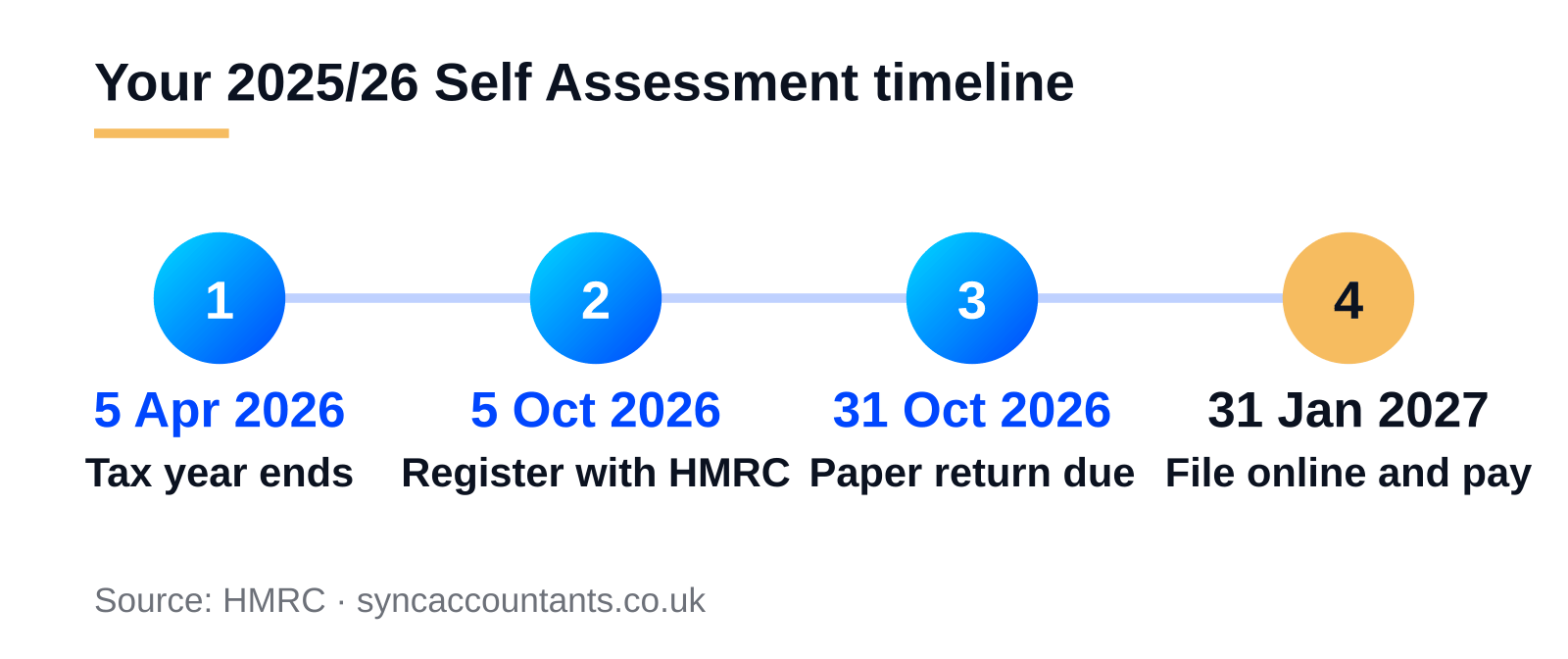
What happens if you miss the 5 October deadline
Missing 5 October does not trigger an instant fixed fine the way a late tax return does. The exposure is a failure to notify penalty, calculated as a percentage of the tax you should have paid, which HMRC calls the potential lost revenue.
Where that percentage lands depends on why it happened and, more than anything, on who spoke first. An unprompted disclosure, meaning you tell HMRC before you have reason to think they are about to find it, carries a much lower minimum than a prompted one. For a genuine oversight put right quickly, the unprompted minimum for non-deliberate behaviour can be nil.
Late filing is a different matter and much less forgiving. Miss 31 January 2027 and there is an immediate £100 penalty, then £10 a day after three months up to £900, then a further 5% of the tax due or £300 at six months and again at twelve, whichever is greater. Late payment adds 5% charges at 30 days, six months and twelve months, plus interest.
The advice does not change if you are already late. Register now, file by 31 January 2027, pay on time, and the exposure usually falls away. Waiting for a platform’s data to produce a letter is the expensive version of the same conversation.
Why your 2025/26 return sets your Making Tax Digital start date
There is a second reason to get 2025/26 right, and most sellers have not spotted it yet. HMRC reads the qualifying income on your 2025/26 tax return to decide whether you must use Making Tax Digital for Income Tax from 6 April 2027. The threshold for that year is £30,000.
Qualifying income is gross trading and property income, before expenses. A seller turning over £34,000 with £9,000 of profit is over the £30,000 line, which surprises people who think about their business in profit terms. The threshold then falls to £20,000 of 2026/27 income, bringing a much larger group of sellers in from 6 April 2028. Our guide to the MTD timeline sets out each phase.
So the return you file by 31 January 2027 is not only a tax bill. It sets how you must keep records for the year after, and quarterly updates are far easier to start from tidy books than from a shoebox. If you would rather not work that out alone, our accountancy services cover the whole cycle.

Frequently asked questions
Do I need to register if I only sell on Vinted?
Only if you are trading. Selling your own used clothes for less than you paid for them is not trading, however many items you shift. Buying to resell, or making items to sell, is trading, and if that gross income passed £1,000 in 2025/26 you need to register by 5 October 2026.
Does the £1,000 apply per platform or across all of them?
Across all of them. The trading allowance is a single £1,000 for the person, not one per shop or per marketplace. Add up your gross takings from every platform and every side trade for the tax year, then compare the total against £1,000.
I started selling in June 2026. When is my deadline?
June 2026 falls in the 2026/27 tax year, so your registration deadline is 5 October 2027 and your first return is due by 31 January 2028. There is nothing to stop you registering earlier, and doing so gets the UTR out of the way well before you need it.
What records should I keep as an online seller?
Keep your platform settlement reports, purchase invoices for stock, postage and packaging receipts, fee statements and your business bank or PayPal records. Settlement reports matter most, because the amount that lands in your bank is net of fees and refunds while your taxable turnover is the gross figure.
Talk to a UK ecommerce accountant
If you’d like a hand applying any of this to your business, our FCCA-chartered team works with over 700 UK ecommerce sellers across Amazon, Shopify, eBay and TikTok Shop. Tell us about your store and we’ll show you exactly what we’d do. Book a free consultation or request a tailored quote.