Do You Pay Tax on eBay Sales? A UK Seller’s Guide
August 6, 2026
MTD for Income Tax: prepare for the second quarterly update on 7 November
August 18, 2026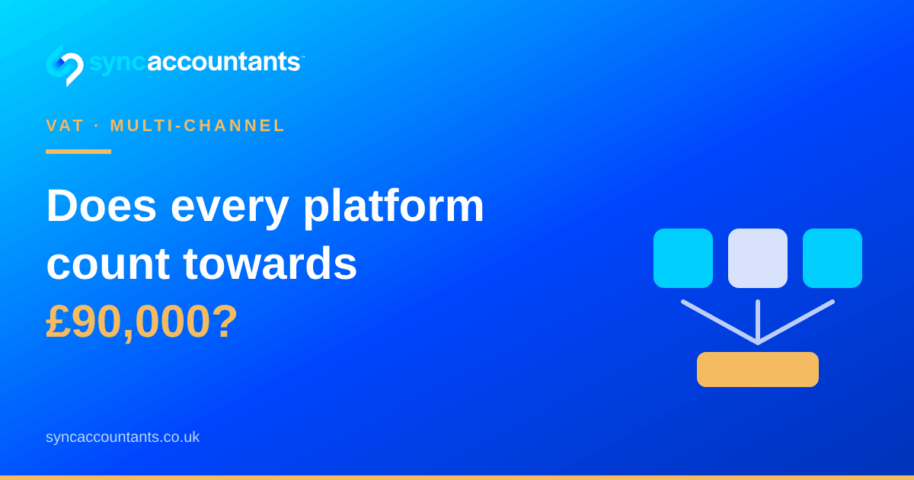
The VAT threshold for ecommerce in the UK is £90,000 of taxable turnover in any rolling 12 month period, and it applies to your business as a whole. Sales through Amazon, eBay, Etsy, Shopify and your own website are added together. No single platform gets its own threshold.
That one sentence catches out a lot of multi-channel sellers, usually in the autumn when Q4 volume pushes a rolling total over the line without anyone noticing. This guide covers what counts, what does not, the two tests HMRC uses, and what to do if you suspect you crossed the threshold months ago. If you would rather someone watched the number for you, our team does exactly that.
What this guide covers
- One threshold, every platform
- Turnover, not profit, and gross, not payout
- The two tests that trigger registration
- What if you crossed the line months ago
- Can you split the business to stay under?
- Sales that do not count towards the threshold
- Frequently asked questions
The VAT threshold for ecommerce in the UK is one figure, not one per channel
HMRC registers a person, not a shop front. If you trade as a sole trader, the person is you, and everything you sell in the course of business counts towards the same £90,000. If you trade through a limited company, the person is the company, and every channel that company sells through counts towards its single total.
So a seller with £42,000 through Amazon, £31,000 through their Shopify store and £19,000 through eBay has £92,000 of taxable turnover and a legal obligation to register, even though no individual channel came close on its own. The platforms have no idea what the others are doing. You are the only one holding the full picture.
The window is a rolling one, which is the part most people get wrong. It is not your accounting year and it is not the tax year. At the end of every calendar month you look back over the previous 12 months and add up the lot, so old months drop off the back as new ones join the front. A strong November can push you over even when your annual figures look comfortable.

It is turnover, not profit, and gross, not what lands in your bank
Taxable turnover is the total value of everything you sell that is not exempt or outside the scope of VAT, as HMRC sets out in its guidance on working out your turnover. Buy stock for £68,000 and sell it for £93,000 and you have crossed the threshold on £25,000 of gross profit. Profitability never enters into it.
The second trap is bigger, and it is specific to marketplace sellers. Your turnover is the price the customer paid, not the amount the platform settles into your account. Amazon deducts referral fees, FBA fees, storage and advertising before it pays you. Etsy takes its transaction and payment processing cuts. If you are tracking the payout figure in your bank statement, you are understating turnover by anywhere between 10 and 30 per cent.
Delivery charged to the customer forms part of the sale price too, as does the value of goods you barter, gift or take for personal use. A seller who looks like they are on £84,000 of payouts can easily be sitting on £96,000 of taxable turnover once the fees go back on.
The two tests that trigger registration
There are two, they work differently, and the deadlines are not the same. The rules on when to register set both of them out.
The backward look. At the end of any month, if your taxable turnover for the previous 12 months has gone over £90,000, you must tell HMRC within 30 days of the end of that month. Registration then takes effect from the first day of the second month after you went over. Cross the line during September and you notify by 30 October, with registration effective from 1 November.
The forward look. If at any point you expect to take more than £90,000 in the next 30 days alone, you must register by the end of that 30 day period, and registration runs from the date you formed that expectation, not the date the money arrives. This one matters for Black Friday and for anyone whose product gets picked up by a large creator. A single viral month can trigger registration on its own.

Need this done for you? Our FCCA-chartered team handles multi-channel VAT registration and monitoring for UK ecommerce sellers every day. Book a free 30-minute call and we’ll show you what we’d do in the first 30 days.
What if you crossed the threshold months ago?
Crossing the VAT threshold without noticing is fixable, and far more common than sellers assume. Register now and be straight about the date you actually went over. HMRC will backdate your registration to the date you should have registered, and you will owe the VAT on sales made from that date, whether or not you charged it at the time.
That is the painful part, because on marketplace sales you cannot go back and ask 400 customers for another 20 per cent, so the VAT comes out of margin already banked. You can, however, reclaim input VAT on stock you still hold and on relevant costs going back four years for goods and six months for services, which usually softens the number.
Penalties are behaviour-based rather than automatic. Under HMRC’s failure to notify penalty rules, a non-deliberate failure disclosed unprompted within 12 months can carry a penalty as low as zero per cent, while the same failure disclosed only after HMRC comes knocking sits in a 20 to 30 per cent band. Deliberate concealment runs to 100 per cent. The gap between telling them and being caught is the whole ball game, so raise it early.
There is also relief for a genuine one-off spike. If your turnover went over £90,000 in the last 12 months but you can show it will stay below the £88,000 deregistration limit over the next 12, you can apply for an exception from registering. You have to apply and evidence it. Deciding for yourself that it was a blip is not the same thing.

Can you split the business across two entities to stay under?
Sellers ask this constantly, usually phrased as putting the eBay shop in a spouse’s name or moving Etsy into a second company. HMRC has specific powers here and uses them.
Where activities have been artificially separated, paragraph 1A of Schedule 1 to the VAT Act 1994 lets HMRC issue a direction treating the separate entities as a single taxable person. In deciding whether a separation is artificial, HMRC looks at how closely the parties are bound by financial, economic and organisational links. Shared stock, shared premises, one bank account funding both, the same person doing all the buying: those links do the damage. HMRC does not need to prove you intended to avoid VAT.
Genuinely separate businesses with different customers, funds and control are a different matter, and there are sound commercial reasons to run more than one entity. That is a structural conversation worth having properly, and our guide to sole trader versus limited company for ecommerce is a sensible starting point. Splitting a single trading operation purely to sit under £90,000 is not a plan, it is a liability with a delay on it.
Sales that do not count towards your threshold
Not everything goes into the total. Exempt supplies and anything outside the scope of UK VAT are excluded, and so are sales where the law makes someone else the supplier.
That last category is worth understanding, because it is regularly misapplied. Where an online marketplace is the deemed supplier, the VAT is the marketplace’s to account for and the sale is not yours for threshold purposes. Those rules bite on goods sold by sellers not established in the UK, and on goods located outside the UK at the point of sale. If you are a UK-established seller shipping goods that are already in the UK, the marketplace is not the deemed supplier and every one of those sales counts as yours.
Seeing “VAT” as a line on an Amazon or eBay settlement report does not mean the platform has taken the registration burden off you. Read it alongside our coverage of the consultation on marketplaces collecting VAT from UK sellers, which would change this picture if it goes ahead, and our guide to tax on eBay sales in the UK if eBay is your main channel.
One point on timing. If you are within about £15,000 of the VAT threshold heading into Q4, model it now rather than in January, because Black Friday cash flow planning and a VAT registration landing in the same fortnight is a rough combination.
Frequently asked questions
Does each sales platform have its own VAT threshold?
No. There is one £90,000 threshold per person or company, covering all business sales. Amazon, eBay, Etsy, Shopify, TikTok Shop and your own website are added together. A platform crossing £90,000 on its own is not the test; your combined rolling 12 month total is.
Is the VAT threshold based on profit or turnover?
Turnover, and gross turnover at that. It is the total value of your taxable sales before platform fees, advertising costs or the cost of your stock. A business with £93,000 of sales and £4,000 of profit must register. A business with £70,000 of sales and £40,000 of profit does not have to.
Does the VAT threshold reset at the start of the tax year?
No, and this catches people out. The main test uses a rolling 12 month window that moves on at the end of every calendar month, so it never resets on 6 April or on your accounting year end. Check the previous 12 months at the end of each month.
What happens if I register for VAT late?
HMRC backdates your registration to the date you should have registered, and you owe the VAT on sales from that date even though you did not charge it. A penalty may follow, based on your behaviour and on whether you came forward or were prompted. Voluntary early disclosure keeps it lowest.
Can I deregister if my sales drop after Christmas?
You can apply to cancel your registration if you expect taxable turnover in the next 12 months to fall below the £88,000 deregistration limit. It is a separate application, not automatic, and deregistering can mean a VAT charge on stock and assets you still hold.
Do I include VAT the marketplace collected in my own turnover?
Only where the marketplace is genuinely the deemed supplier, which applies to overseas sellers and to goods outside the UK at the point of sale. For a UK-established seller with UK stock, the sale is yours and counts in full towards your threshold.
Talk to a UK ecommerce accountant
If you’d like a hand applying any of this to your business, our FCCA-chartered team works with over 700 UK ecommerce sellers across Amazon, Shopify, eBay and TikTok Shop. We track the rolling total across every channel so the threshold never arrives as a surprise, and we handle registration when it does. Tell us about your store and we’ll show you exactly what we’d do, or read more about our accountancy service for ecommerce sellers. Book a free consultation or request a tailored quote.