Payment on Account 2026: What UK Online Sellers Owe by 31 July
July 16, 2026
Do You Pay Tax on eBay Sales? A UK Seller’s Guide
August 6, 2026
Mandatory Direct Debit for VAT and PAYE is an HMRC proposal, not yet law, that would require most VAT-registered businesses and employers to pay their return liabilities by Direct Debit. The consultation opened on 23 June 2026 and closes at 11:59pm on 16 August 2026. Around 2.4 million individuals and companies would be in scope.
- What HMRC is actually proposing
- What mandatory Direct Debit for VAT and PAYE would change
- When HMRC would take the money
- How HMRC would make you use it
- Who would be left out
- What to do before 16 August
- Frequently asked questions
If you run an online shop, your VAT bill is probably the largest single payment you make all year, and you almost certainly choose the day you pay it. HMRC wants to change that. A consultation now open would hand the timing decision to HMRC for most businesses. Nothing has been decided yet, and the window to have your say closes in August. Here is what is on the table and what it would mean for your bank balance.
What HMRC is actually proposing
HMRC and HM Treasury published a consultation on requiring payment of VAT and PAYE return liabilities by Direct Debit on 23 June 2026. It runs for eight weeks and closes at 11:59pm on 16 August 2026. The stated aim is timelier payment: less late payment, fewer payments landing against the wrong reference, and less avoidable tax debt.
The scale is worth pausing on. As at March 2025 there were 2.73 million businesses registered for VAT and PAYE, and HMRC estimates around 2.4 million individuals and companies would fall inside the new rules, sole traders and limited companies alike. If you are VAT registered, run a payroll, or both, you are in scope by default.
One thing to be clear about: this is a consultation, not draft legislation, and no implementation date has been set. HMRC has said the timeline and exchequer impact are yet to be confirmed, and a further technical consultation would normally follow before anything took effect.

What mandatory Direct Debit for VAT and PAYE would change
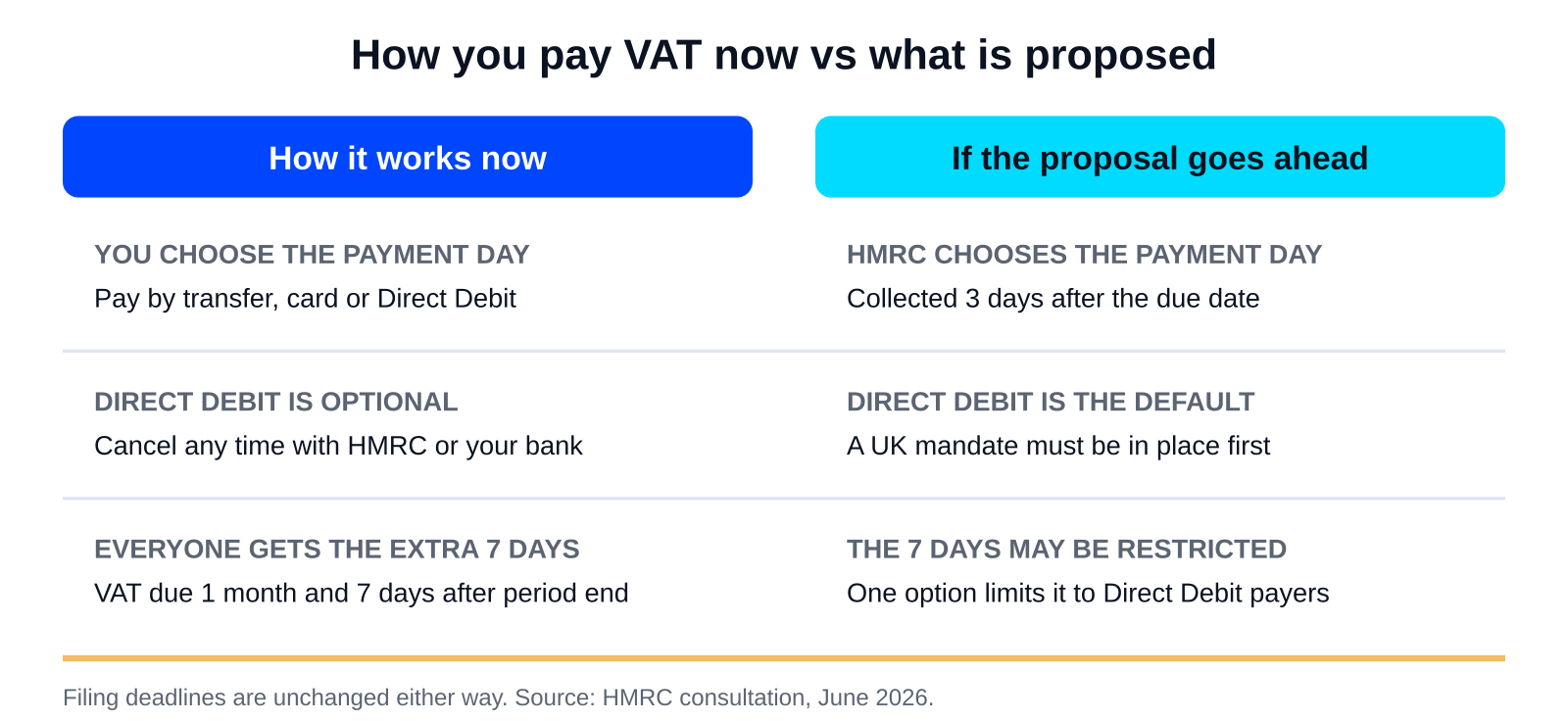
Plenty of businesses already pay VAT by Direct Debit and are perfectly happy with it. For them, very little changes. The businesses that need to pay attention are the ones who currently pay manually by bank transfer, on a day of their choosing, usually the last possible one.
That habit is not laziness. It is deliberate cash-flow management, and it matters most in ecommerce because your money arrives in lumps. Amazon settles you roughly fortnightly. A Shopify payout clears on its own schedule. If a VAT bill is due on a Thursday and your next marketplace payout lands on the Friday, paying manually lets you line the two up. An automated collection does not care about your payout calendar.
The second change is the one people miss: you would need a UK bank account with a valid Direct Debit mandate already in place before the start date. Mandates fail for boring reasons, such as changing bank or restructuring the business, and any of those could leave you technically non-compliant on a payment you fully intended to make.
Filing does not change at all. You would still submit your VAT return exactly as you do now, on the same deadline. This proposal is only about how the resulting liability gets collected.
When HMRC would take the money
The timing differs between the two taxes, which is easy to trip over if you have both. For VAT, HMRC would collect three days after the due date. Your VAT return and payment are already due one calendar month and seven days after the end of your VAT period, so the collection would sit just beyond that. For a quarter ending 30 June, the due date is 7 August and collection would follow shortly after.
For PAYE, collection would happen shortly after the 22nd of the month, or four working days after you file the return, whichever applies. That mirrors the existing electronic PAYE payment deadline of the 22nd.
In both cases HMRC would tell you what is coming no later than three working days before it takes the money. Three working days is not much warning if you are juggling a stock order and a payout that has not cleared. That is the practical heart of the objection, and it is a fair thing to say in a consultation response.
Need this done for you? Our FCCA-chartered team handles VAT returns and payroll for UK ecommerce sellers every day, and we can map your VAT payments against your marketplace payout dates so a fixed collection date never catches you short. Book a free 30-minute call and we’ll show you what we’d do in the first 30 days.
How HMRC would make you use it
The consultation floats two levers, and they are very different in character.
The first is a straight penalty for not paying by Direct Debit, applied either on each occasion or on a cumulative basis. Read that carefully, because it is the detail that has drawn the most criticism: a penalty of this kind could bite even where you paid your tax in full and on time, simply because you used the wrong payment method. Paying correctly but manually would become a compliance failure in its own right.
The second lever is quieter and arguably has more teeth. HMRC could restrict the existing deadline extensions, seven days for VAT and three days for PAYE, so that only Direct Debit payers get them. No penalty, no new offence. Your deadline simply moves forward by a week if you stay off Direct Debit. For a business with a large quarterly VAT bill, losing seven days of float every quarter is a real cost.
HMRC is also considering incentives rather than punishments, including faster repayment processing for businesses on Direct Debit. If you are regularly in a VAT repayment position, which many importers and zero-rated sellers are, that is worth weighing on the other side of the ledger.
Who would be left out
Some businesses could not be brought in even if the government wanted to, because of how the Direct Debit system works. The BACS scheme caps a single Direct Debit at £20 million, so anyone above that would keep using other electronic methods, and the scheme only works with UK bank accounts, which leaves overseas businesses without one outside the rules. That last point matters if you sell into the UK through a non-UK entity.
Beyond the technical limits, HMRC proposes the usual digital exclusion grounds: religious belief, disability, age, remote location where banking access is genuinely difficult, and businesses in insolvency proceedings. These would be exceptions on application rather than automatic carve-outs, so do not assume one applies to you without checking.
What to do before 16 August
Three things, and the first two take about ten minutes each.
Check you actually have a working UK Direct Debit mandate for VAT, and for PAYE if you run a payroll. If you changed bank recently, or restructured from sole trader to limited company, there is a decent chance the mandate did not follow you across.
Then look at your next four VAT due dates against your expected marketplace payouts. If a fixed collection three days after the due date would have left you short in any of those quarters, you have a real cash-flow problem to solve now rather than a hypothetical one to worry about later. Our guide to cash-flow forecasting through the Q4 peak is a sensible place to start, and the same logic that catches out sellers at the July payment on account deadline applies here.

Finally, respond, through the online form on the consultation page or by email to payeconsultations@hmrc.gov.uk before 11:59pm on 16 August 2026. Small businesses are consistently under-represented in tax consultations, which is precisely why proposals arrive looking as though nobody thought about seasonal cash flow. If you want us to submit a response for you, tell us what the collection date would do to your business and we will write it up. While you are at it, a second consultation on extending VAT liability to online marketplaces for UK sellers closes on 18 August, and if you sell on Amazon, eBay or Etsy that one may matter to you even more.
Frequently asked questions
Is paying VAT by Direct Debit compulsory now?
No. Direct Debit is entirely optional today and you can still pay by bank transfer, debit card or corporate credit card. The proposal to make it mandatory is at consultation stage only, with no implementation date announced, so nothing about your current VAT or PAYE payments needs to change yet.
Could I be penalised even if I pay my VAT on time?
Potentially, yes. One of the two enforcement options in the consultation is a penalty for not paying by Direct Debit, which would apply based on the payment method used rather than on whether the tax was paid on time. That is one of the main concerns being raised in responses.
How much notice would HMRC give before taking payment?
No later than three working days before collection. For VAT the collection would fall three days after your due date, and for PAYE shortly after the 22nd of the month or four working days after filing. You would know the amount in advance, but not choose the date.
What happens if there is not enough money in the account?
A failed collection leaves the liability unpaid, so late-payment interest and penalties would apply in the normal way, and your bank may charge you for the failed instruction. This is why matching your VAT due dates against your marketplace payout schedule matters more under an automated system than a manual one.
Does this affect me if I am not VAT registered?
Only if you run a payroll. The proposal covers VAT return liabilities and PAYE return liabilities, so a sole trader below the VAT threshold with no employees is outside it. If you employ anyone, including yourself as a director on a salary, the PAYE side would apply to you.
Would I still file my VAT return the same way?
Yes. Filing obligations and deadlines are untouched by this proposal, and Making Tax Digital for VAT rules continue to apply as they do now. The only thing under consultation is how the resulting payment reaches HMRC.
Talk to a UK ecommerce accountant
If you’d like a hand applying any of this to your business, our FCCA-chartered team works with over 700 UK ecommerce sellers across Amazon, Shopify, eBay and TikTok Shop. We can check your Direct Debit mandates, model your VAT payments against your payout dates, and submit a consultation response on your behalf before 16 August. Tell us about your store and we’ll show you exactly what we’d do. Book a free consultation or request a tailored quote. You can also read more about how we work with ecommerce businesses or how a specialist VAT accountant improves your recovery.