Marketplace VAT for UK Sellers: What HMRC’s New Consultation Could Mean
June 25, 2026
Payment on Account 2026: What UK Online Sellers Owe by 31 July
July 16, 2026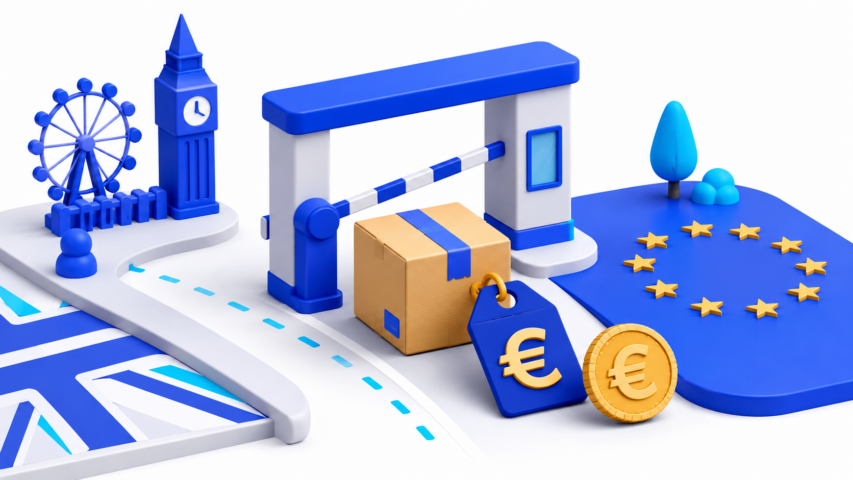
The new EU customs charges affect your UK business if you ship goods worth €150 or less directly to EU consumers. Since 1 July 2026, the EU has scrapped its duty-free threshold and applies a temporary €3 customs duty per item on those low-value parcels. If you hold stock inside the EU, the impact is much smaller.
- What the new EU customs charges are
- Do the new EU customs charges affect your UK business?
- How the €3 customs duty is charged
- The hidden cost: surprise bills and refused parcels
- What UK sellers should do now
- Frequently asked questions
If you sell to customers in the EU, you have probably seen headlines about new charges on parcels arriving from outside the bloc. A lot of it is aimed at the likes of Shein and Temu, but the same rules catch UK sellers too. Here is what actually changed on 1 July 2026, who it hits, and the practical steps that protect your margins and your delivery experience.
What the new EU customs charges are
For years, goods worth €150 or less could enter the EU free of customs duty. That exemption ended on 30 June 2026. From 1 July 2026, the EU applies a temporary flat customs duty of €3 per item on low-value consignments, meaning those valued up to €150, when they arrive from outside the EU. The goal is to level the playing field between direct-to-consumer imports and traditional retail, and to claw back duty on the billions of small parcels now entering the bloc.
The €3 is charged per item, not per parcel. The European Commission’s own example is a package holding one T-shirt and one watch, which faces €6 because it contains two items. The flat rate is an interim measure. It runs until 1 July 2028, after which normal customs duty rates apply once the EU Customs Data Hub is operational.
A second charge is on the way. The EU has proposed a separate handling fee to cover the cost of processing all those small parcels. The amount is not fixed yet, though €2 per parcel (with a lower rate of around €0.50 for goods sent to an EU warehouse) is the figure under discussion, with a start date expected in autumn 2026. VAT itself has not changed: parcels under €150 were already subject to import VAT, usually collected through the Import One-Stop Shop (IOSS) at the point of sale.
Do the new EU customs charges affect your UK business?
The short answer is yes, if you post goods from the UK straight to an EU customer and the order is worth €150 or less. Since Brexit, the UK is a non-EU country, so your parcels cross a customs border every time they head into the bloc. The end of the duty-free threshold means even a £10 order now carries a customs charge it would have escaped a week ago.
The impact is smaller in a few situations. If you hold stock inside the EU, say in an Amazon fulfilment centre in Germany or a third-party warehouse in the Netherlands, the sale to your customer is a domestic EU movement rather than a low-value import, so the €3 duty does not apply to that order. Goods worth more than €150 already attracted customs duty, so nothing changes for higher-value items. Genuine gifts between private individuals stay out of scope, though a business cannot dodge the charge by labelling commercial orders as gifts.
Business-to-business shipments and your own bulk imports into an EU warehouse follow the normal customs rules rather than the €3 flat rate. So the sellers most exposed are small and mid-sized UK businesses that ship lots of low-value orders one at a time from the UK. If that describes your model, the new charge lands on a large share of your EU sales.
How the €3 customs duty is charged
The duty is due when your goods enter the EU. It is a customs charge, so it is collected through your carrier or your customs declaration, not through IOSS, which only handles the VAT. Because the €3 applies per commodity type, a mixed parcel can trigger the charge more than once.
A three-item order made up of a garment, a phone case and a pair of shoes could carry €9 in duty, sitting on top of the import VAT and any carrier handling fee. For a low-margin product, that is enough to wipe out the profit on the sale. We break down the €3 customs duty in detail in a separate guide, with a full worked example and how the tariff headings are counted.
The hidden cost: surprise bills and refused parcels
The charge itself is only part of the story. What matters commercially is who pays it, and when. If you ship on a Delivered Duty Unpaid basis, the duty and VAT are billed to your customer before the courier hands over the parcel. Plenty of shoppers refuse that unexpected bill, so the parcel comes back, the sale is lost, and you carry the cost of the return.
Shipping on a Delivered Duty Paid basis puts the charge on you at the point of sale. That protects the customer experience, but it eats into your margin unless you have built it into your pricing. Neither option is free. The right choice depends on your average order value, your repeat-purchase rate, and how much a poor delivery experience would cost you in reviews and refunds.
Not sure how exposed you are? Our FCCA-chartered team works with UK ecommerce sellers shipping into the EU every day. Book a free 30-minute call and we’ll work out how much of your EU revenue the new charges touch, and the cleanest way to handle them.
What UK sellers should do now
Start by working out how exposed you are. Pull your EU order data for the last few months and see what share sits at or below €150 and ships from the UK. That single number tells you how much of your EU revenue the new charge actually touches.
From there, a few moves protect your position. Decide on Delivered Duty Paid or Delivered Duty Unpaid deliberately rather than by default, and make sure your checkout is honest about any charges before the customer pays. Model the €3, and the proposed handling fee, into your EU pricing so a popular three-item order does not quietly turn a profit into a loss. If your volumes justify it, holding stock inside the EU can sidestep the per-parcel duty, though it brings its own VAT registration and bookkeeping obligations. Keep your IOSS registration active so the VAT side stays smooth, and it pays to review your VAT position while you are reworking the numbers.
This is the first step in a bigger overhaul, not the end of it. Larger changes to VAT and customs land in 2028, so it is worth getting your head around the wider 2028 customs and VAT reforms now rather than being caught out twice. If EU sales are a serious part of your business, our ecommerce accounting team can help you build the numbers into a plan.
Frequently asked questions
Do the new EU customs charges apply to UK businesses?
Yes. Since 1 July 2026 the €150 duty-free threshold has gone, so goods you ship from the UK to EU consumers face a €3 per-item customs duty when the order is worth €150 or less. UK sellers count as non-EU sellers, so your parcels are treated the same as any other import into the bloc.
How much is the new EU customs charge?
It is a temporary flat €3 per item on consignments up to €150, in force from 1 July 2026 until 1 July 2028. Because it is charged per item and not per parcel, a two-item order faces €6. A separate handling fee, likely around €2 per parcel, is proposed for later in 2026 but has not been confirmed yet.
Does the €3 duty replace VAT?
No. The €3 is a customs duty, charged on top of import VAT. VAT on parcels under €150 has not changed and is usually collected through IOSS at the point of sale. On a single order your customer could see the item price, the VAT, the €3 duty and a carrier handling fee all listed separately.
Can I avoid the charge by holding stock in the EU?
Often, yes. If your goods are already inside the EU when a customer orders, the sale is a domestic movement rather than a low-value import, so the €3 duty does not apply. You would instead pay duty and VAT when you bulk-import your stock, and you may need an EU VAT registration. Whether that maths works depends on your volumes and margins.
Do the charges apply to gifts or second-hand items?
Genuine gifts between private individuals are outside the scope. A business selling goods, new or used, cannot treat commercial orders as gifts to avoid the duty. If you sell through a marketplace or your own store, assume your EU orders are in scope unless a specific relief applies.
When does the €2 handling fee start?
It is not confirmed. The EU has proposed a handling fee separate from the €3 duty, with the amount and start date still being finalised and expected in autumn 2026. The figure under discussion is €2 per parcel, with a reduced rate for goods sent to EU warehouses. We will update this article once it is set.
Talk to a UK ecommerce accountant
If you’d like a hand applying any of this to your business, our FCCA-chartered team works with over 700 UK ecommerce sellers across Amazon, Shopify, eBay and TikTok Shop. Tell us about your store and we’ll show you exactly what we’d do. Book a free consultation or request a tailored quote.