HMRC Signed Me Up for Making Tax Digital: What Online Sellers Do Next
October 21, 2026
The Autumn Budget 2026 for online sellers has one headline: from 1 October 2027, Amazon, eBay and other online marketplaces will collect VAT on sales by UK businesses that are VAT-registered or sell more than £90,000 on a single platform. Alongside it, the trading allowance triples to £3,000, and late submission penalties on Making Tax Digital quarterly updates are waived for 2027-28 for those required to join that April.
The Chancellor delivered the Budget on Wednesday 28 October 2026. This guide covers only what the published Budget documents announce, with the start date for each measure, because for a seller the date usually matters more than the rate. We update this page at every Budget, so the latest changes are always at the top.
In this guide
- Marketplaces will collect VAT on your sales from October 2027
- The trading allowance rises to £3,000
- Making Tax Digital: no quarterly update penalties for April 2027 joiners
- Mileage, fuel, business rates and tariffs
- What the Autumn Budget 2026 did not change for online sellers
- What to do now
- Previous Budgets for online sellers
- Frequently asked questions
Marketplaces will collect VAT on your sales from October 2027
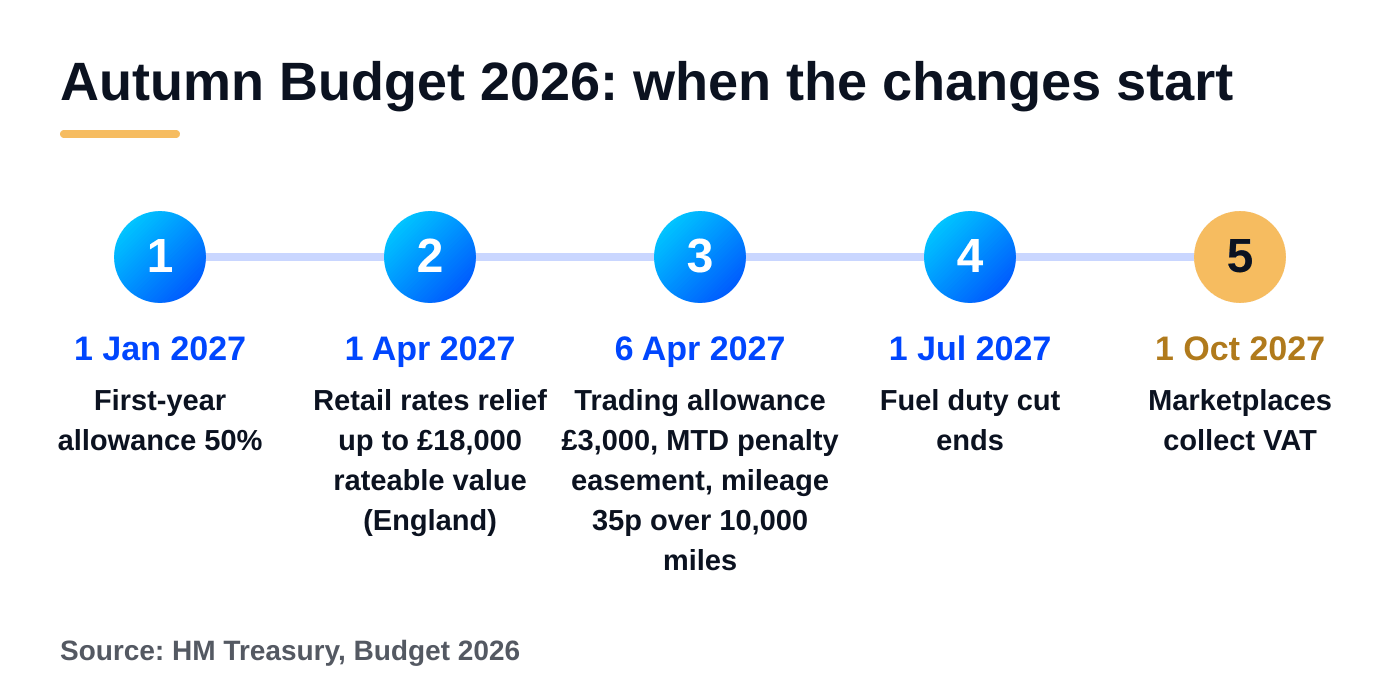
This is the change that matters most. Since 2021, online marketplaces have collected VAT on sales by overseas sellers. The government has now announced it will extend those rules to UK businesses where the goods are in the UK at the point of sale, starting from 1 October 2027. Legislation and HMRC guidance will follow before then.
You are in scope if your business is VAT-registered, however little you sell on the platform. You are also in scope if you are not registered but sell more than £90,000 a year on any one marketplace. That £90,000 test applies to each platform separately, so an unregistered seller with £50,000 on Amazon and £30,000 on eBay is outside the rules on both. Your combined turnover still counts towards the normal £90,000 VAT registration threshold, though. If it passes £90,000 you must register, and once registered every platform is in scope.
Three kinds of sale are excluded: second-hand goods, which keep their usual VAT treatment, personal sales of your own belongings, and sales to other businesses. The government dropped the VAT rate relief it had consulted on for small sellers, because the £90,000 platform threshold keeps them out altogether.

What it does to your VAT return is not settled yet. The consultation proposed treating your sale to the marketplace as zero-rated, so you would stop declaring output VAT on those sales but keep reclaiming VAT on your costs. The government response does not confirm that detail. It says HMRC guidance will explain the accounting before the start date, that sellers in scope can apply for monthly VAT returns to help cash flow, and that it will take more time to consider how the Flat Rate Scheme will work with the new rules. If you use the Flat Rate Scheme and sell on marketplaces, watch that guidance closely. Our page on marketplace VAT for UK sellers covers how the current rules split responsibility.
The trading allowance rises to £3,000
From 6 April 2027, the trading allowance goes up from £1,000 to £3,000. If your gross trading income is £3,000 or less, you will not need to report it to HMRC through Self Assessment. If it is more, you can deduct a flat £3,000 instead of claiming your actual expenses.
The allowance is measured on income before expenses, not profit. A seller turning over £2,800 on Vinted or Etsy with no other trading income drops out of reporting altogether. A seller turning over £20,000 with £1,500 of real costs is better off claiming the £3,000. One with £8,000 of stock and fees should keep claiming actual expenses. Work it out each year, because the better choice can change as your margins move.
Making Tax Digital: no quarterly update penalties for April 2027 joiners
Sole traders and landlords with qualifying income over £30,000 join Making Tax Digital for Income Tax from 6 April 2027. The Budget policy costings say that HMRC will not charge late submission penalties on quarterly updates for 2027-28 to taxpayers required to join that April.
Read the small print before relaxing. The easement covers quarterly updates only. You still have to submit every quarterly update before HMRC will accept your final return, and the normal penalties for missing the annual return deadline still apply. Your digital records still need to be in place from 6 April 2027. The easement only makes 2027-28 a cheaper year to miss a quarterly deadline. Our Making Tax Digital guide covers the full timetable.
Not sure where the Budget leaves your shop? Our FCCA-chartered team handles VAT, marketplace accounting and Making Tax Digital for UK ecommerce sellers every day. Book a free 30-minute call and we’ll show you what changes for you and when.
Mileage, fuel, business rates and tariffs
Several smaller measures change what it costs to run a selling business. None is dramatic on its own, but together they are worth a line in your forecast.
- Mileage rates. The approved mileage rate for cars and vans rises to 55p a mile for the first 10,000 business miles, effective from 6 April 2026, so it covers the current tax year. The rate above 10,000 miles rises to 35p from 6 April 2027. Sole traders and partnerships using simplified mileage get the same rates.
- Fuel duty. The 5p a litre cut is extended to 1 July 2027. On that date duty goes up by 5p and is uprated by RPI, then by RPI every April from 2028.
- Business rates in England. From 1 April 2027, Small Business Rate Relief for retail, hospitality and leisure properties gives 100% relief up to a rateable value of £18,000 (was £12,000), tapering to £21,000 (was £15,000). This applies to qualifying retail, hospitality and leisure properties in England only, as business rates are devolved in Scotland, Wales and Northern Ireland.
- Import tariffs. Tariffs are suspended on 72 more products from 5 August 2026, and existing suspensions are extended for 361 products in 2027-28. If you import, check your commodity codes against the duty suspensions list.
- Capital allowances. The main rate first-year allowance on new plant and machinery rises from 40% to 50% for spending on or after 1 January 2027 (cars and second-hand assets excluded). The main rate writing-down allowance falls from 14% to 12% from 1 April 2027 for companies and 6 April 2027 for sole traders and partnerships.
- Reverse charge on overseas services. From 1 April 2027 the Budget restricts the reverse charge on services supplied from overseas to VAT-registered businesses. If you pay overseas-invoiced fees, such as some marketplace or advertising charges, watch for the detail.
What the Autumn Budget 2026 did not change for online sellers
The basic, higher and additional rates of income tax on earnings and trading profits are unchanged, as are the headline rates of National Insurance and VAT, and the main rate of corporation tax stays at 25%. The full list of Budget decisions has no change to the £90,000 VAT registration threshold, to dividend tax rates or the £500 dividend allowance, or to income tax bands, which stay frozen until April 2031 as announced last year.
This Budget also confirmed that customs duty relief on imports of £135 or less will be removed, with new customs arrangements, from October 2028. Making Tax Digital still drops to £20,000 of qualifying income from April 2028, as announced earlier. Rates did go up elsewhere: tax on property and savings income rises by 2 percentage points from 6 April 2027. Reliefs were also cut, with Business Asset Disposal Relief, used when you sell your business, limited to £500,000 of lifetime gains from the same date.
What to do now
- Split your sales by platform. Work out your annual sales on each marketplace and on your own website. If you are not VAT-registered, that tells you whether any one platform is near £90,000. If you are registered, it tells you how much of your turnover moves to marketplace collection in October 2027.
- Model the cash flow. If marketplaces start accounting for VAT on your sales, your VAT returns may swing towards repayments. Ask us whether monthly returns would suit you.
- Check the trading allowance. If your gross trading income is small, see whether £3,000 takes you out of reporting from 2027-28, or beats your actual expenses.
- Get MTD-ready anyway. If you join in April 2027, choose software and start digital records now. The penalty easement does not remove the quarterly updates.
- Check your mileage claims. The 55p rate is effective from 6 April 2026, so it applies to 2026-27 business miles.
Measures announced at a Budget still need legislation and HMRC guidance, and detail can change before they start. We will update this page as that guidance is published.
Previous Budgets for online sellers
Autumn Budget 2025. Announced the removal of customs duty relief on imports of £135 or less, now confirmed from October 2028. Dividend tax rates rose by 2 percentage points from 6 April 2026, to 10.75% basic and 35.75% higher, and income tax thresholds were held until April 2031. Our guide to how the Budget affects cheap imports covers the import change in detail.
Autumn Budget 2024. Raised employer National Insurance to 15% from April 2025 and cut the threshold at which employers start paying it to £5,000. Capital gains tax rates rose to 18% and 24%.
Frequently asked questions
Will Amazon and eBay collect VAT for UK sellers?
Yes, from 1 October 2027, subject to legislation. Online marketplaces will account for VAT on sales by UK businesses that are VAT-registered, or that sell more than £90,000 a year on that platform, where the goods are in the UK at the point of sale. Second-hand goods, personal sales and business-to-business sales are excluded.
Does the £90,000 marketplace threshold apply across all platforms?
No. For businesses that are not VAT-registered, the £90,000 threshold applies separately to annual sales on each platform. Your total turnover across all channels still counts towards the normal £90,000 VAT registration threshold, which the Budget did not change.
What is the new trading allowance?
From 6 April 2027 the trading allowance rises from £1,000 to £3,000. If your gross trading income is £3,000 or less you do not need to report it through Self Assessment. Above that, you can deduct £3,000 instead of your actual expenses.
Are there Making Tax Digital penalties in the first year?
For taxpayers required to join MTD for Income Tax in April 2027, HMRC will not charge late submission penalties on quarterly updates for 2027-28. You still need to submit the updates before your final return, and annual return deadline penalties still apply.
Did the Autumn Budget 2026 change the VAT threshold?
No. The Budget did not announce a change to the £90,000 VAT registration threshold, and it did not raise the headline rate of VAT. The main VAT change for online sellers is marketplace collection from October 2027.
Talk to a UK ecommerce accountant
If you’d like a hand working out what the Autumn Budget 2026 means for your shop, our FCCA-chartered team works with over 700 UK ecommerce sellers across Amazon, Shopify, eBay and TikTok Shop. Tell us about your store and we’ll show you exactly what changes and when. Book a free consultation or request a tailored quote.