Marketplace VAT for UK Sellers: What Changes From October 2027
November 11, 2026
Self Assessment Deadline for Online Sellers: 31 January 2027 and the Dates Before It
November 19, 2026
Can HMRC track Vinted sales? Yes. Since 2024, Vinted has had to report sellers who make 30 or more sales, or take more than €2,000, in a year. But being reported is not the same as owing tax. Selling your own unwanted things is usually tax-free; buying to resell is likely to be trading, and trading income above the allowance is taxable.
We have written about this before, in a guide to whether HMRC can track Vinted sales and in one about paying tax on selling old items online. The Autumn Budget on 28 October 2026 changed the picture, because the trading allowance is set to rise from £1,000 to £3,000 from April 2027. We have merged those two articles into this one guide and brought it up to date. It is written for the people we see every day through our accounting for online sellers work: Vinted, eBay, Depop and Etsy sellers, from wardrobe clear-outs to full-time resellers.
- What Vinted reports to HMRC
- Selling your own things: usually no tax
- When selling becomes trading
- The £1,000 trading allowance, and £3,000 from April 2027
- Three sellers, three outcomes
- What to do if you are trading
- Vinted and HMRC FAQs
How HMRC track Vinted sales: what Vinted reports
Since 1 January 2024, digital platforms including Vinted, eBay, Etsy and Depop must collect details about their sellers and report them to HMRC. The reports go in once a year, by 31 January, covering the previous calendar year. So your sales made during 2026 are reported by 31 January 2027. This is the answer to the question “can HMRC track Vinted sales?”: it does not need to go looking, because the platforms hand the information over on a schedule. Our guide to the platform reporting deadline covers the timings in more detail.
Platforms do not report everyone. Vinted skips you only if, in a calendar year, you made fewer than 30 sales of goods and received €2,000 (about £1,700) or less. Hit either of those numbers, 30 sales or more than €2,000, and you are reported: either one is enough to get you reported, one about how many times you sold, one about how much you received.
When a platform reports you, it sends your full name, home address, date of birth, tax identification number, and your income from sales. The details are set out in HMRC’s guidance for online sellers.
Here is the part people miss. Being reported and owing tax are two separate tests. The first test, 30 sales or €2,000, decides whether the platform tells HMRC about you at all. The second test, whether you are trading and over the trading allowance, decides whether you actually owe tax. You can be reported and owe nothing, which is the position most wardrobe-clearers are in. Being under the reporting limits does not make trading income tax-free. It only means the platform does not report you.
| Test | What triggers it | What it means |
|---|---|---|
| Being reported by the platform | 30 or more sales, or more than €2,000, in a calendar year | Vinted sends your details and income to HMRC |
| Needing to report trading income | You are trading and your gross sales are over the trading allowance | You must report the income to HMRC. Whether you owe tax depends on your profit. |

Selling your own things: usually no tax
If you are selling your own unwanted belongings, HMRC has been clear that being reported does not automatically mean you owe tax. In December 2024 it confirmed there were no changes to the tax rules for people selling their unwanted possessions online. HMRC also says you are unlikely to owe tax on household belongings, such as the contents of a loft or a garage. Clearing out a wardrobe and pocketing the proceeds is not normally a taxable event, even once Vinted has told HMRC your name and income.
The distinction HMRC draws is between selling what you own and trading. Selling your own unwanted belongings is not normally trading. If you buy or make things to sell at a profit, you are likely to be trading, and then the income is taxable above the allowance. We cover the line between the two in the next section.
One exception to keep in mind, and it has nothing to do with trading. Capital Gains Tax can apply when you sell a personal possession for £6,000 or more, for example a piece of jewellery, a watch or a painting, even if you are not trading at all. The annual Capital Gains Tax allowance is £3,000 for 2026 to 2027. If you sell something valuable, check whether you actually made a gain before assuming the sale is tax-free. gov.uk has guidance on Capital Gains Tax on personal possessions.
When selling becomes trading
HMRC decides whether you are trading by weighing up what it calls the “badges of trade”. None of them decides the question on its own, but together they show whether what you are doing looks like a business. In broad terms, they are:
- Whether you set out to make a profit.
- How often you sell: repeated, systematic sales point towards trading.
- Whether you buy items specifically to resell them.
- Whether you repair or improve items to sell them for more.
- How quickly you sell things after buying them.
- Whether you sell the way a shop would.
Items you inherited or were given are less likely to count as trading, because you did not buy them with resale in mind. For the full list and HMRC’s own commentary, read HMRC’s badges of trade. If several of those badges describe what you do on Vinted, eBay or Depop, you are probably trading, and the next section applies to you.
The £1,000 trading allowance, and £3,000 from April 2027
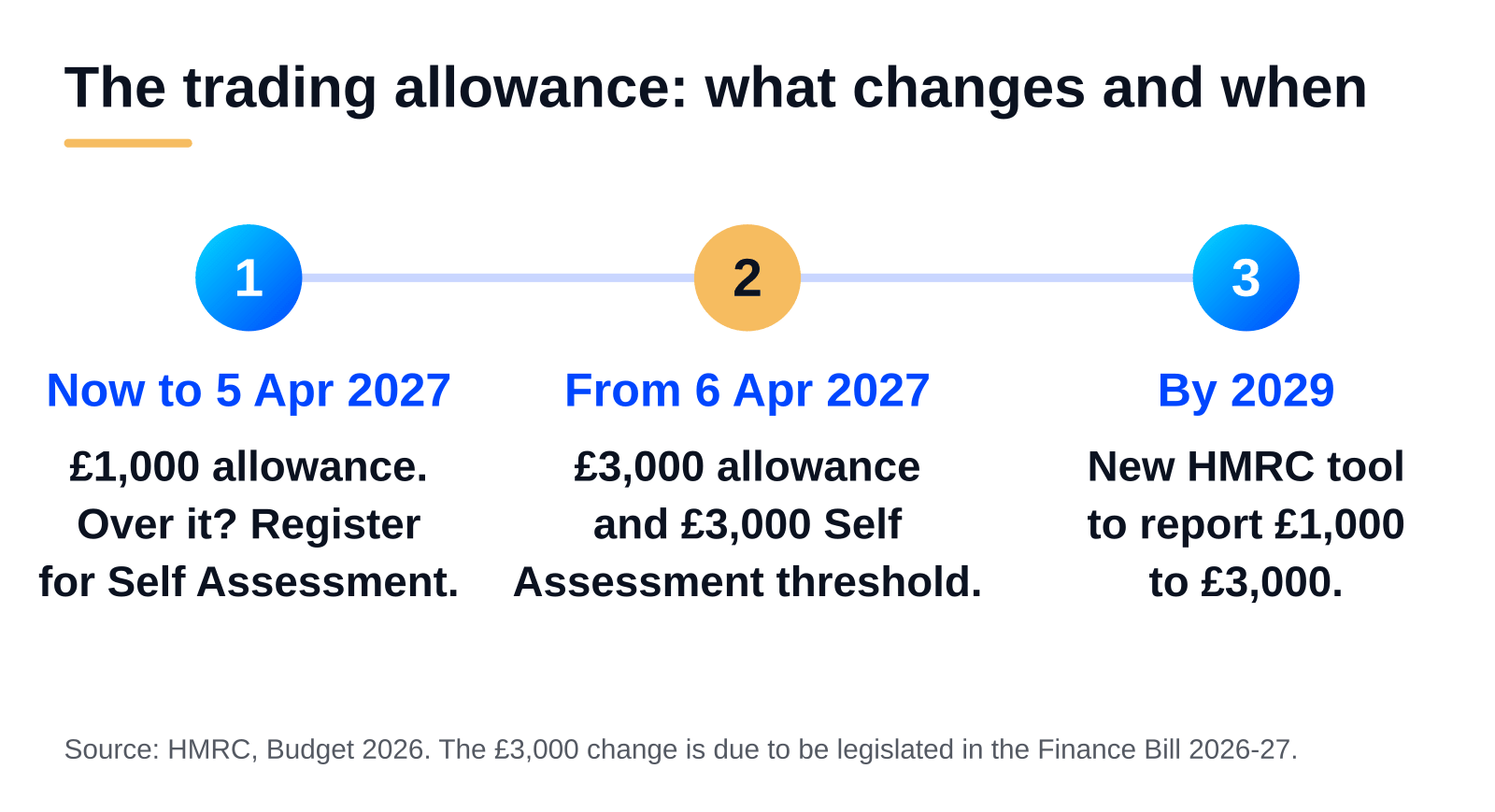
If you are trading, the first £1,000 of gross trading income each tax year is tax-free. Gross means your sales before costs, so it is not the same as £1,000 of profit. This applies for the 2025 to 2026 and 2026 to 2027 tax years. That is the position today, and it is what you should plan around until anything else becomes law. See the gov.uk page on tax-free allowances on trading income.
If your gross trading income goes over £1,000, you do not simply pay tax on everything above it. You get a choice: deduct the £1,000 allowance and pay tax on the rest, or ignore the allowance and deduct your actual costs instead. Whichever leaves you with less taxable profit is the better option, but you can only use one of them, never both.
The allowance is not available for income from a partnership, from a company you or a connected person own or control, or from your or your spouse’s or civil partner’s employer. So it covers genuine small sole traders, but not every income source.
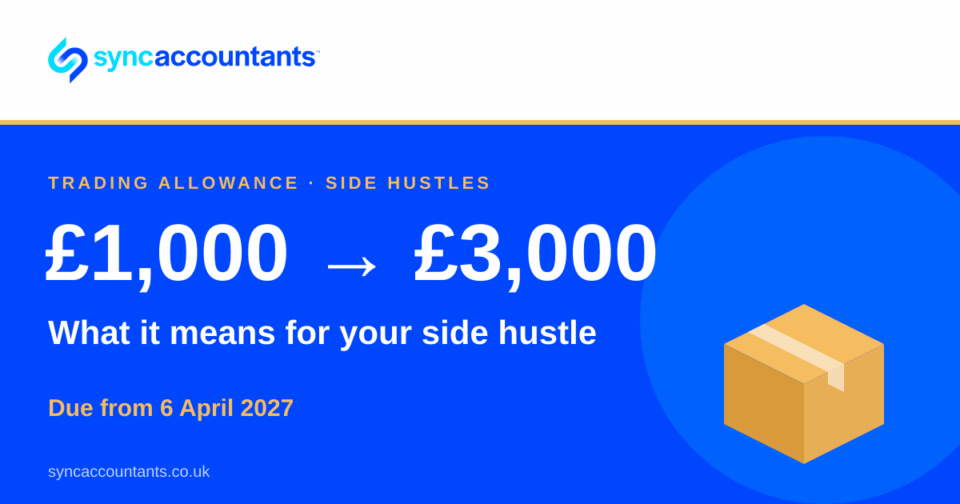
Now the change. At the Autumn Budget on 28 October 2026, the government announced that the trading allowance will rise to £3,000 from 6 April 2027, which is the 2027 to 2028 tax year onwards, and the government’s policy paper says the Self Assessment reporting threshold will also rise to £3,000. It is not law yet: the legislation will be in the Finance Bill 2026-27. But HMRC’s own pages are not consistent on how income between £1,000 and £3,000 will be reported, so do not assume that income under £3,000 never needs reporting. We go into the detail in our guide to the £3,000 trading allowance, and we will update this article when HMRC clarifies the reporting.
Three sellers, three outcomes
Priya: clearing out her wardrobe
Priya clears out her wardrobe on Vinted during 2026: 45 sales, £900 in total, all clothes she originally bought for herself. Vinted reports her to HMRC by 31 January 2027, because she made 30 or more sales. So yes, HMRC can track Priya’s Vinted sales. But Priya is very unlikely to be trading, because she bought those clothes to wear, not to resell. She is unlikely to owe any tax, and the report is not a tax bill. Being reported and owing tax are different things, and Priya is the proof.
Ella: buying to resell
Ella buys clothes from charity shops and resells them on Vinted and eBay. In 2025 to 2026 her sales were £2,400 and her costs, covering stock, postage and platform fees, were £900. She is trading, and her gross sales are over £1,000, so she must report the income to HMRC. She compares her two options: using the £1,000 allowance leaves £1,400 taxable, while deducting her £900 of actual costs leaves £1,500 taxable. The allowance is the better choice for her, and she cannot use both.
Once the £3,000 allowance starts, Ella’s £2,400 of sales would sit under it. But HMRC has not yet said how income between £1,000 and £3,000 will be reported, so she should watch for that guidance rather than assume. The same trading rules apply across platforms, so our guide to tax on eBay sales covers the same numbers for eBay sellers.
Marcus: one valuable item
Marcus sells a watch he inherited for £7,500 on eBay. He is very unlikely to be trading: he did not buy watches to resell, and inherited items are less likely to count as trading anyway. But because he sold a personal possession for £6,000 or more, Capital Gains Tax may apply even though he is not running a business. Marcus should check whether he made a gain, and whether his £3,000 annual allowance (shared with any other gains that year) covers it. This is one to take advice on.
Not sure if your selling counts as trading? Our FCCA-chartered team works with UK online sellers every day. Book a free 30-minute call and we will tell you whether you need to report your sales.
What to do if you are trading
The deadlines are short and easy to miss. If you are trading, your gross sales for 2025 to 2026 were over £1,000, and you were not already registered for Self Assessment, you should have told HMRC by 5 October 2026. The Self Assessment return itself is then due online by 31 January 2027, with any tax paid by the same date. If you missed the October date, act now rather than waiting for a reminder, because the return date has not moved.
Here is the practical version of what to do:
- Work out your gross sales for the tax year, which runs 6 April to 5 April, not the calendar year the platform reports on. Vinted’s January report covers the calendar year, so you will need to split it.
- Keep records of stock, postage and fees, so you can compare your actual costs against the allowance each year and pick the better option.
- Register for Self Assessment if you have not. Our walkthrough shows you how to register for Self Assessment as an online seller.
- Keep the platform’s annual report with your records, so you can match it to your return.
And if you are not trading, just selling your own things, you usually do not need to do any of this. Keep it simple, but be honest with yourself about which side of the line you sit on, because if you hit the 30-sale or €2,000 limits, Vinted will already have told HMRC your income.
Vinted and HMRC FAQs
Does Vinted report to HMRC?
Yes, if you make 30 or more sales of goods in a calendar year, or receive more than €2,000 (about £1,700). Vinted reports your full name, home address, date of birth, tax identification number and your income from sales to HMRC by 31 January for the previous calendar year. If you are under both limits, Vinted does not report you at all.
Do I pay tax on selling my old clothes on Vinted?
Usually not. Selling your own unwanted belongings is not normally trading, and HMRC says you are unlikely to owe tax on household belongings such as the contents of a loft or garage. You may still be reported to HMRC if you hit the 30-sale or €2,000 platform limits, but being reported is not the same as owing tax. The exception is trading, where you buy or make things to sell at a profit.
How many sales on Vinted before HMRC knows?
Fewer than 30 sales and €2,000 or less in a calendar year means Vinted does not report you. Hit 30 sales, or go over €2,000, and you are reported. Being under the limits does not make trading income tax-free. Note the reporting covers the calendar year, not the tax year, so your 6 April to 5 April figures for Self Assessment may differ from what Vinted has sent to HMRC.
Is the trading allowance £1,000 or £3,000?
It is £1,000 now, for the 2025 to 2026 and 2026 to 2027 tax years. The Autumn Budget on 28 October 2026 announced a rise to £3,000 from 6 April 2027, but it is not law yet: the legislation will be in the Finance Bill 2026-27. But HMRC’s own pages are not consistent on how income between £1,000 and £3,000 will be reported, so do not assume that income under £3,000 never needs reporting.
Do I need to declare Vinted sales if I made a loss?
Selling your own unwanted things, even at a loss, is not normally trading, so there is normally nothing to declare. If you are trading and made a loss, the loss is worked out on your Self Assessment return, and you may still need to file if your gross sales were over £1,000. Remember the trading allowance is based on gross sales, not profit.
Talk to a UK ecommerce accountant
If you’d like a hand applying any of this to your business, our FCCA-chartered team works with over 700 UK ecommerce sellers across Amazon, Shopify, eBay and TikTok Shop. Tell us about your store and we’ll show you exactly what we’d do. Book a free consultation or request a tailored quote.