Salary or dividends for ecommerce directors: the 2026/27 numbers
September 8, 2026
Your Companies House identity verification deadline is not 18 November 2026. It is the date your company’s next confirmation statement falls due. Companies House will not accept that statement until every director has verified and supplied a personal code, so for many companies the real date has already passed.
18 November 2026 is being quoted everywhere as the cut-off. It is the end of a transition period, which is a different thing. This guide sets out the date that actually binds you, the separate timing rule for people with significant control, what happens to your filings if someone has not verified, and a three-step check you can run today.
- Why 18 November 2026 is not your deadline
- Who has to verify, and by when
- What happens if a director has not verified
- How to verify, and the two routes
- The three-step check to run this week
- Frequently asked questions
Why 18 November 2026 is not your deadline
Identity verification became a legal requirement on 18 November 2025. Companies House opened a 12-month transition period on that date, which it expects to complete around mid-November 2026. Its own announcement is blunt about the start date: “This date is not a deadline.”
The transition window is when everyone has to get verified, and it does end in mid-November 2026. The point is that its end is almost never the date that reaches you first. Your position inside the window is set by your company’s own filing calendar, not by the end of it. Note that the confirmation statement date is the date the statement is made up to, and you then have 14 days to file it. A company with a confirmation statement date in October 2026 has weeks. A company whose statement fell in February 2026 was already required to have every director verified, seven months ago.
So the Companies House identity verification deadline is a different date for every company, and it is printed on your own register entry. This matters because “we have until November” is the wrong mental model. It produces a plan to deal with it in late October, which for most companies is after the date that actually bound them. Treating November as the deadline is how you find out at the worst moment that you cannot file.

Who has to verify, and by when
Three different timing rules apply, and the Companies House identity verification deadline you are on depends on the role you hold rather than the company you hold it in.
Directors already in post verify at the same time as the company files its first annual confirmation statement falling due after 18 November 2025. Each director’s personal code goes on the statement, and there is a declaration to tick confirming every director is verified. New directors must be verified before they start acting as a director and before the appointment is filed, and the same applies at incorporation.
A person with significant control who is also a director gets a 14-day window that starts the day after the confirmation statement date. Companies House gives the worked example of a statement date of 31 March 2026, producing a window of 1 to 14 April 2026. A PSC who is not a director is on a completely different trigger: the first 14 days of their birth month. Someone born on 24 February has a window of 1 to 14 February. Both rules come from Companies House guidance for PSCs, they describe PSCs already on the register during the transition, and you can check your own 14-day dates on the register. Someone newly registered as a PSC is on a different footing, so check the dates shown against their own entry.
One trap here catches people who have done everything else right. A PSC role is a separate obligation from a director role. Supplying your personal code on the confirmation statement covers you as a director; if you are also a PSC you still have to provide your verification details for the PSC role through the dedicated PSC verification service, inside your own 14-day window. You verify your identity once, but you tell Companies House about each role.
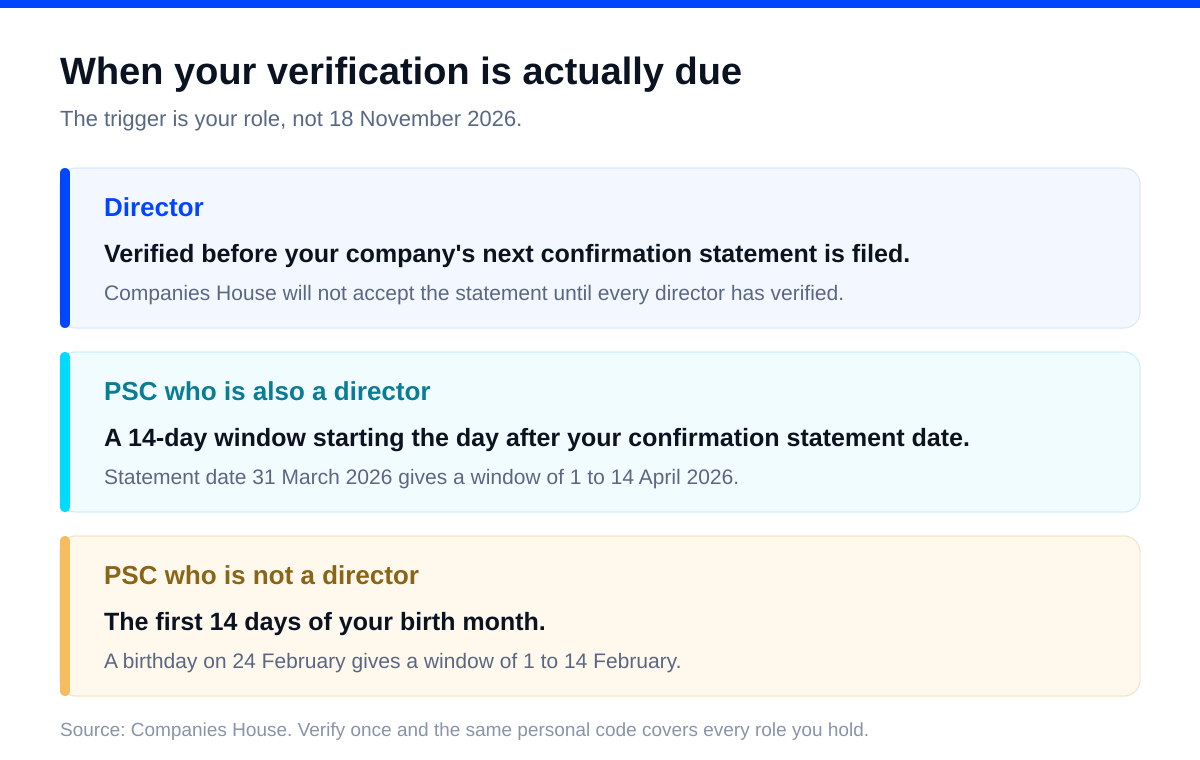
If you hold both roles you only verify once. In most cases a person verifies a single time, receives one personal code, and uses that same code for every appointment they hold. A director of four companies does not do this four times.
What happens if a director has not verified
The filing stops. Companies House states that it will not accept a company’s confirmation statement until all directors have verified their identity. One unverified co-director blocks the statement for the whole company. The company’s other filings, accounts included, can still go in through a verified officer or an authorised provider, so it is the confirmation statement that stops.
It is also an offence, once your own deadline has passed. A director still inside their window during the transition is not committing it. Section 167M of the Companies Act 2006, inserted by the Economic Crime and Corporate Transparency Act 2023, says an individual must not act as a director unless their identity is verified. It is a summary offence and the penalty is a fine. There is no prison sentence attached to it, and section 167M(6) is explicit that a contravention does not affect the validity of anything the director has done. Section 167M(2) puts a matching duty on the company itself, and where the company breaches it the offence is committed by the company and by every officer in default, with a shadow director treated as an officer. This is not only the unverified director’s problem. GOV.UK also states that someone who has not verified will not be able to make filings for their company or start a new one.
Companies House has said it will take a proportionate approach to enforcement during the transition. That is worth knowing and it is not worth relying on. The blocked filing is the consequence that bites first, and it bites on a date you do not control.
Need this done for you? Sync Accountants is registered with Companies House as an Authorised Corporate Service Provider, so our FCCA-led team can verify your directors’ identities and handle your confirmation statement filing. Book a free 30-minute call and we’ll show you what we’d do in the first 30 days.
How to verify, and the two routes
There are two ways to do it, and they lead to the same place. The first is GOV.UK One Login, which you do yourself. Usually that means a passport, a UK photocard driving licence, or a biometric residence permit or card. If you hold none of those, One Login has other routes, including confirming your details against a bank or building society record, or an in-person check at a Post Office, which still needs an accepted photo ID. Which alternatives are open to you depends on your circumstances.
The second is an Authorised Corporate Service Provider. GOV.UK names accountants and solicitors explicitly, but the firm has to be registered with Companies House as an ACSP, which means being supervised for anti-money-laundering purposes and having its application approved. A registered ACSP can verify your identity on your behalf. That is the route to take if the One Login document check has already failed for you, or if you would rather your accountant handled it alongside the filing. We wrote about choosing an approved provider earlier this year.
Either way, the output is the same: a Companies House personal code, a unique identifier that links your verified identity to your roles. If you went through One Login you will find it under “Manage account” in your Companies House account; if an ACSP verified you, they pass it on to you, which may be by email. Keep it somewhere you can find it, because it is what you supply when a role you hold has to be confirmed, starting with the confirmation statement.
The three-step check to run this week
- Find your confirmation statement date. Search your company on the Companies House register and look at the confirmation statement section. That date, not November, is your real Companies House identity verification deadline. You have 14 days after it to file, so it is the point everyone needs to be verified by rather than the last possible day.
- List every director and PSC. Include the co-founder who does nothing day to day, the family member holding shares, and anyone who is a PSC without being a director, because they are on the birth-month rule and nobody ever remembers them.
- Collect each personal code now. Ask every person on the list for their code and store the set together. Chasing a dormant co-director for a code the week the statement is due is the situation this check exists to avoid.
If the company is dormant or you have been meaning to wind it up, the verification requirement applies anyway for as long as it is on the register. It may be the prompt to close the company properly rather than carry it. And if you are still deciding whether a limited company is the right structure for your ecommerce business, this is one more piece of the admin that comes with it.
Frequently asked questions
Is 18 November 2026 the Companies House identity verification deadline?
No. 18 November 2025 started a 12-month transition period which completes around mid-November 2026. GOV.UK said of the 18 November 2025 start that the date is not a deadline. The transition does end in mid-November 2026, but that end is almost never the date that reaches a company first. The date that binds a director is the company’s next confirmation statement, which for many companies falls well before November.
What happens if one director has not verified?
Companies House will not accept the company’s confirmation statement until every director has verified. One unverified director blocks that filing for the whole company, though other filings such as accounts can still go in through a verified officer or an authorised provider. Acting as a director without being verified, once that director’s own deadline has passed, is also a summary offence under section 167M of the Companies Act 2006, punishable by a fine.
Do I need to verify separately for each company I am a director of?
No. In most cases you verify once and receive a single Companies House personal code. You then use that same code to confirm you are verified for every appointment you hold. Note that being both a director and a PSC still means telling Companies House about each role separately, even though you only verify once.
Can my accountant verify my identity for me?
Yes. GOV.UK names accountants and solicitors as Authorised Corporate Service Providers, provided the firm is registered with Companies House as an ACSP. A registered ACSP can verify your identity on your behalf, which is the usual route when the GOV.UK One Login document check does not work for you.
When does a PSC who is not a director have to verify?
In the first 14 days of their birth month. Someone born on 24 February has a window of 1 to 14 February. A PSC who is also a director is on a different rule: a 14-day window starting the day after the company’s confirmation statement date. Both describe PSCs already on the register during the transition, and PSC details go in through the dedicated PSC verification service, not on the confirmation statement.
What is a Companies House personal code?
It is the unique identifier you receive once your identity is verified, linking that verified identity to your Companies House roles. If you verified through One Login you find it under Manage account in your Companies House account; if an ACSP verified you, they pass it to you. You supply it when a role you hold has to be confirmed, starting with the confirmation statement.
Talk to a UK ecommerce accountant
If you’d like a hand applying any of this to your business, our FCCA-led team works with over 700 UK ecommerce sellers across Amazon, Shopify, eBay and TikTok Shop. Tell us about your store and we’ll show you exactly what we’d do. Book a free consultation or request a tailored quote.