Mandatory Direct Debit for VAT and PAYE: What HMRC Is Proposing
July 30, 2026
VAT Threshold for Ecommerce in the UK: Do All Your Sales Platforms Count Together?
August 13, 2026
Tax on eBay sales comes down to one question: are you trading? If you are, you pay Income Tax once your eBay profit passes the £1,000 trading allowance in a tax year. Separately, eBay must report your account to HMRC once you pass 30 sales or roughly £1,700 in a calendar year, whether or not you owe any tax at all.
- Are you trading on eBay, or just clearing the loft?
- The £1,000 trading allowance, and what it doesn’t cover
- Tax on eBay sales vs being reported to HMRC
- Registering with HMRC and the deadlines that matter
- eBay’s 2026 fee changes and what they do to your margin
- Sold on eBay for years and never told HMRC?
- Frequently asked questions
Selling on eBay used to feel private. It isn’t any more. Since January 2024 the platform has had to share seller data with HMRC, and headlines about a “side hustle tax” have made plenty of casual sellers nervous for no reason, and plenty of genuine traders nervous for exactly the right one. This guide separates the two, walks through the actual thresholds, and covers eBay’s own 2026 fee changes while we’re at it.
Are you trading on eBay, or just clearing the loft?
HMRC does not care what account type you ticked when you signed up to eBay. A “private seller” account and a “business seller” account are eBay’s labels, not HMRC’s, and choosing “private” does not exempt you from tax if what you are actually doing is trading.
The real test is whether you are trading, and HMRC uses a set of guidelines known as the badges of trade to work it out. No single factor decides it alone, but the questions that matter most are: did you buy the item planning to resell it for a profit, do you do this regularly rather than as a one-off, and have you altered or improved items before selling them on. Clearing out a wardrobe you have owned for years is not trading, even if that takes forty separate listings in one weekend. Buying stock, wholesale lots, or items specifically to flip for a margin, on a repeated basis, almost always is.
The distinction decides which rules apply at all. A one-off clearout has no tax consequences beyond the trading allowance below. Genuine trading brings you into Income Tax, and eventually Self Assessment, National Insurance, and potentially VAT.
| Probably just clearing out | Probably trading |
|---|---|
| Selling things you already owned and used | Buying items specifically to resell |
| A one-off clearout, not repeated | Regular, repeated sales over time |
| Items sold roughly as you had them | Items altered, improved or bundled before sale |
| No profit motive when you bought them | Bought with profit in mind from the start |
A seller who buys clearance stock from a wholesaler and relists it as a side income is trading from their first sale, even if that first sale runs at a loss. A seller offloading old textbooks, clothes their kids have outgrown, or a broken laptop for parts is not, however many separate listings that takes. If this sounds like your situation either way, our guide to paying tax on selling old items online goes deeper on the personal-clearout side of the line.
The £1,000 trading allowance, and what it doesn’t cover
If you are trading, the first number that matters is £1,000. HMRC’s trading allowance lets you earn up to £1,000 of gross trading income in a tax year completely tax-free, with nothing to report. Gross means before eBay’s fees, postage costs, or what you paid for the stock, so a seller with £4,000 of sales and £3,200 of costs still measures against the £1,000 threshold on the sales figure, not the £800 profit.
Cross that line and you have a choice. Either deduct your actual costs and pay tax on the real profit, or deduct the flat £1,000 allowance instead and pay tax on whatever is left of your income above it. You cannot do both. Most sellers with real costs, stock, postage, eBay fees, are better off deducting actual expenses once turnover is meaningfully above £1,000, because the flat allowance stops being worth much once genuine costs exceed it.
This is where a lot of eBay sellers get confused, and the confusion runs in exactly the wrong direction.
Tax on eBay sales vs being reported to HMRC
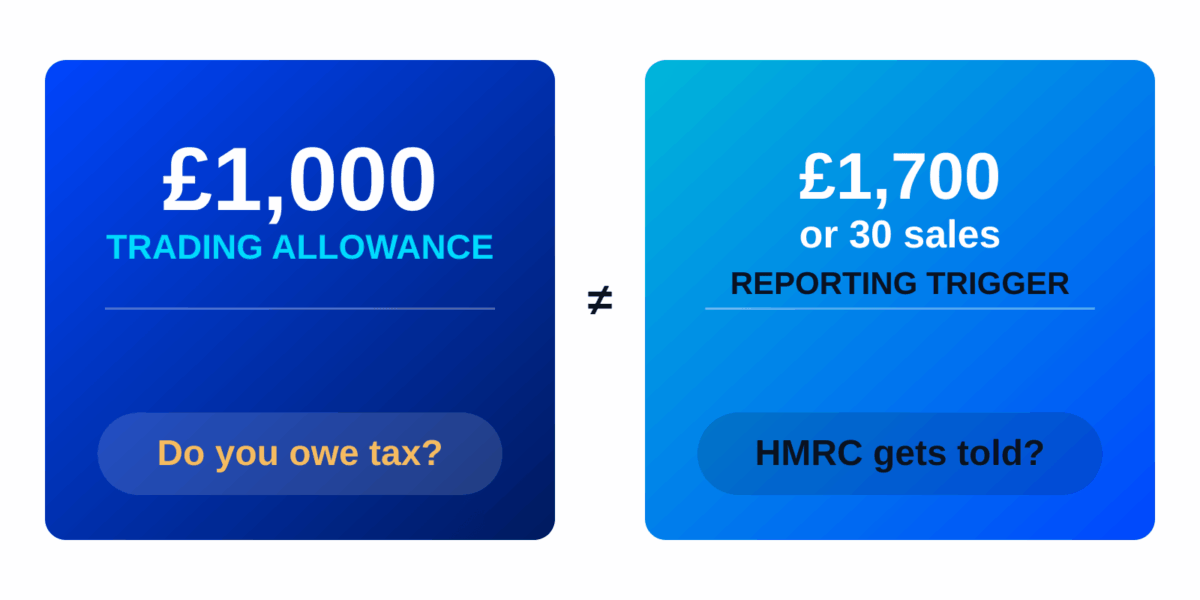
The £1,000 trading allowance is a tax threshold. It has nothing to do with the separate rule that decides when eBay hands your details to HMRC, and treating the two as the same number is the single most common mistake sellers make on this topic.
Since January 2024, digital platforms including eBay, Vinted, Etsy and Depop have had to report seller information under rules adopted from the OECD’s international reporting framework. eBay must report you if, in a calendar year, you make 30 or more sales of goods, or you are paid more than roughly €2,000 (about £1,700; the exact sterling figure moves slightly year to year with the exchange rate), whichever happens first. Cross either line and eBay reports your name, address, bank details and total sales to HMRC in full, regardless of whether you were trading or simply having a big clearout.
That last point is worth sitting with. Reporting and owing tax are not the same event. A seller who sold £2,000 of personal belongings they no longer wanted gets reported to HMRC and owes nothing, because none of that was trading income. A seller who made £900 of genuine trading profit stays under the trading allowance and owes nothing either, reported or not. What the reporting rule actually does is put your numbers in front of HMRC, so that if you should have declared something and did not, that mismatch is visible from January each year rather than invisible forever. Our separate guide to the HMRC digital platform reporting deadline covers the mechanics in more detail, and the same rule applies almost identically to Amazon sellers if you trade across both.
Need this sorted properly? Our FCCA-chartered team works out whether your eBay activity counts as trading, gets you registered with HMRC on time, and keeps your records straight for whichever allowance actually suits you. Book a free 30-minute call and we’ll show you what we’d do in the first 30 days.
Registering with HMRC and the deadlines that matter
If your eBay trading profit is above £1,000 for a tax year, you need to register for Self Assessment. The deadline is 5 October following the end of that tax year, not the following January, which catches people out because the payment deadline of 31 January is the one everyone has actually heard of.
Register online and HMRC issues you a Unique Taxpayer Reference. From there you file a return each year covering 6 April to 5 April, with the online filing deadline and the payment deadline both falling on 31 January after the tax year ends. Keep records of every sale, every eBay and postage fee, and what you paid for stock, because you need them to calculate your actual profit even if you eventually choose the flat allowance instead.
If your business turnover, across everywhere you sell, not just eBay, passes £90,000 in any rolling 12-month period, you also need to register for VAT within 30 days of the month you crossed the threshold. Most part-time eBay sellers are nowhere near this, but it catches up faster than people expect once a side hustle turns into the main income. If you sell across several marketplaces, the turnover from all of them counts towards the same £90,000, not just eBay’s share of it.
eBay’s 2026 fee changes and what they do to your margin
None of this next part is a tax rule, but it changes the profit figure you are calculating tax on, so it belongs in the same conversation.
From 12 February 2026, eBay increased its fixed per-order fee for business sellers from 30p to 40p on orders over £10. On a high-volume, low-margin account that is a genuine dent rather than pocket change: a seller doing 200 qualifying orders a month is paying an extra £20 a month for nothing they can pass straight on to a buyer without losing sales.
The bigger margin risk sits in eBay’s seller performance system. If your account falls to “Below Standard” on the 20th of a month, usually through late dispatch or too many item-not-as-described cases, eBay adds 6 percentage points on top of your normal final value fee for the whole of the following month. A category that normally carries a 12.8% final value fee jumps to 18.8% while you are Below Standard, on every sale that month, not just the ones that caused the problem. Private sellers pay no eBay fees at all since October 2024, which is a reminder that this section only bites once you are a business seller in eBay’s own system, a separate switch from whether HMRC considers you a trader.
Sold on eBay for years and never told HMRC?
If you have read this far and recognised yourself as someone who should have registered years ago, the honest answer is that it is fixable, and it gets more expensive the longer you wait, not the other way round.
HMRC has a formal disclosure route for exactly this situation, and coming forward voluntarily is treated far more leniently than being caught out by a data mismatch after eBay’s next annual report lands. Penalties for failing to notify HMRC about taxable income are graded by how the failure happened (careless versus deliberate) and how long it went on, and a voluntary, unprompted disclosure sits at the bottom of every penalty band HMRC uses. Waiting for a letter after eBay has already reported you pushes you into a worse band automatically.
In practice this means gathering your eBay sales history, downloadable from your account and usually available going back several years, working out your actual profit year by year, and registering only for the years that count as trading rather than assuming you owe something on every sale you have ever made. A one-off clearout ten years ago is still not trading income today. If you are not sure where the line falls in your own sales history, that judgement call is exactly the kind of thing worth a second opinion before you file anything.
Frequently asked questions
Do I have to pay tax on eBay sales in the UK?
Only if you are trading. You pay Income Tax once your genuine trading profit passes the £1,000 trading allowance in a tax year. Selling unwanted personal items you already owned, even in large numbers, is not trading and does not usually create a tax bill, though you should still keep basic records in case HMRC asks.
What is the trading allowance for eBay sellers?
It is a £1,000 tax-free threshold on gross trading income each tax year. Below £1,000 you generally have nothing to report. Above it, you choose between deducting the flat £1,000 or your actual costs, but not both, and most sellers with real stock and postage costs are better off using actual costs once turnover is well above £1,000.
Does eBay report my sales to HMRC?
Yes, if you make 30 or more sales or are paid more than roughly £1,700 in a calendar year, whichever comes first. eBay has reported UK seller data to HMRC since January 2024 under international digital platform reporting rules. Being reported does not automatically mean you owe tax, it means HMRC has your figures on file.
I only sell my own unwanted things on eBay. Do I still owe tax?
Generally no. Selling personal possessions you originally bought for your own use, rather than to resell for profit, is not trading under HMRC’s rules, however many listings that takes. The trading allowance and Self Assessment rules apply to trading income, not to clearing out a house.
What happens if I have never told HMRC about my eBay income?
Come forward voluntarily rather than waiting to be asked. HMRC’s penalties for undeclared income are lower for unprompted, voluntary disclosures than for cases where HMRC finds the gap first, and eBay’s annual reporting to HMRC makes that gap increasingly likely to surface on its own.
Do eBay sellers need to register for VAT?
Only once your business turnover across all your sales channels, not just eBay, passes £90,000 in any rolling 12-month period. Most part-time and small full-time eBay sellers stay well under this, but it is worth checking annually rather than assuming it will never apply.
Talk to a UK ecommerce accountant
If you’d like a hand applying any of this to your business, our FCCA-chartered team works with over 700 UK ecommerce sellers across Amazon, Shopify, eBay and TikTok Shop. We can work out whether your eBay activity counts as trading, get you registered before the 5 October deadline, and untangle years of unreported sales if that’s where you are starting from. Tell us about your store and we’ll show you exactly what we’d do. Book a free consultation or request a tailored quote. You can also read more about how we work with ecommerce businesses.