Companies House identity verification deadline: it is your confirmation statement, not 18 November
September 17, 2026
VAT on discounts and vouchers: a Black Friday guide for UK online sellers
October 1, 2026
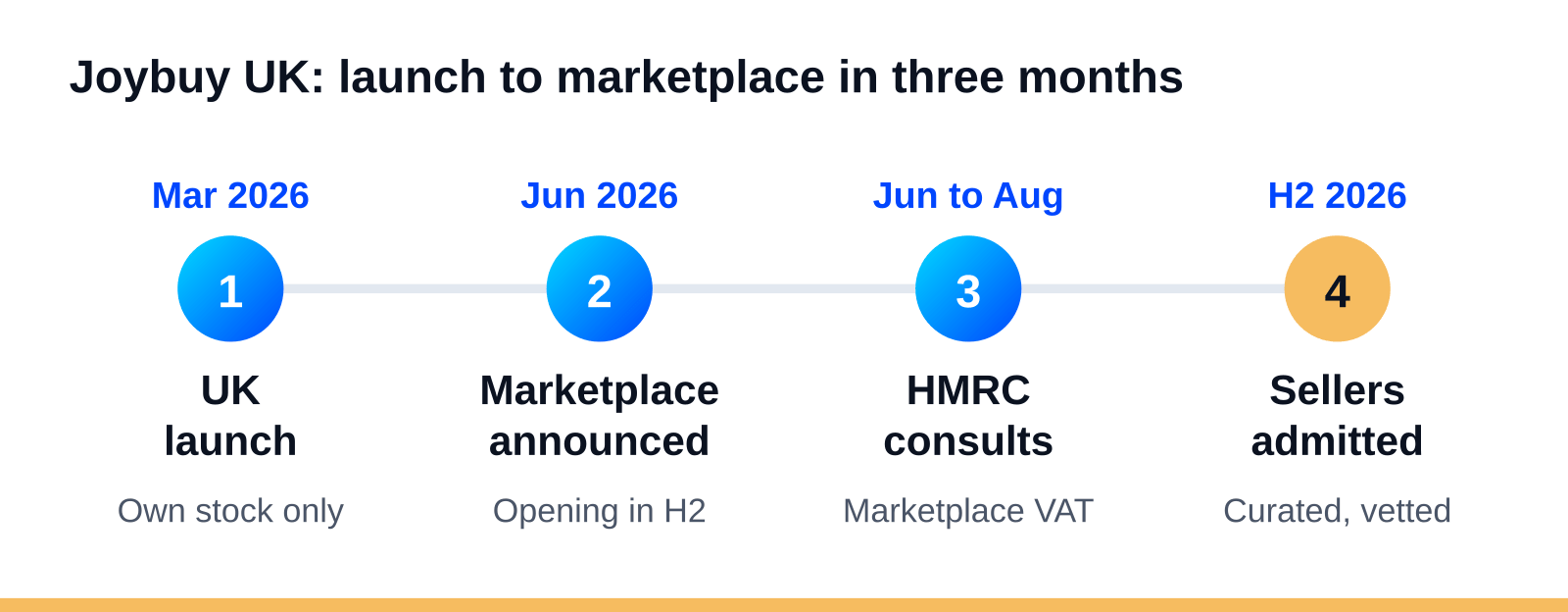
Selling on Joybuy UK is not possible yet. JD.com’s UK platform launched in March 2026 selling only its own stock, and it opens to third-party sellers in the second half of 2026. The selection will be curated rather than open, so the first question is whether you would be accepted at all.
Most Amazon sellers first heard of Joybuy as a shopping app. It is about to become something more awkward: a second marketplace, arriving with no published fee schedule and no seller agreement, at the same moment HMRC is consulting on who accounts for VAT on marketplace sales. This guide covers what is confirmed, what is guesswork, and what to do with the time you have.
- What Joybuy is right now
- What we know about the seller programme
- Why you should distrust the fee figures
- The VAT change that matters more than the fees
- Your 90-day readiness checklist
- What a second marketplace does to your books
What Joybuy is right now, and what it is not yet
Joybuy is owned by JD.com, one of China’s largest online retailers. It launched in the UK in March 2026 with more than 100,000 products across technology, home appliances, beauty, homeware and groceries, and went live in Germany, France, the Netherlands, Belgium and Luxembourg on the same day.
The important detail for sellers is what it sells. Everything currently on Joybuy is sold by Joybuy. It buys stock from brands and suppliers and holds it in its own UK distribution centres in Milton Keynes and Luton. That is a retailer, closer to Costco than to Amazon, and it is why there has been no way in for third-party sellers until now.
In June 2026, three months after launch, JD.com confirmed it would open the platform to third-party sellers in the second half of the year. It is recruiting marketplace chiefs for the UK, France and Germany, and separately a cross-border chief tasked with bringing Chinese sellers into international markets. That second appointment tells you who else will be in the aisle with you.
What we actually know about the seller programme
Very little, and that is the honest answer. What has been confirmed is the shape rather than the detail.
The marketplace will be heavily curated. JD.com has said it will vet the sellers it admits, working with trusted brands first, which trade press has compared to the approach Tesco took with its own marketplace. This is not an open platform where you create an account and list by the afternoon. Someone will decide whether you are in.
That single fact should reshape how you prepare. On Amazon, readiness means having stock and a Seller Central account. Here, readiness means being the kind of business a category manager picks: consistent stock availability, clean product data, a track record they can verify, and competitive pricing they can check against your other channels. None of that can be assembled in the week the applications open.
Need this done for you? Our FCCA-chartered team handles multi-channel ecommerce accounting for UK sellers every day. Book a free 30-minute call and we’ll show you what we’d do in the first 30 days.
Why you should distrust every fee figure you have seen
Search for Joybuy seller fees and you will find confident numbers. One widely repeated set claims referral fees of 5 to 10 per cent, against 8 to 15 per cent for Amazon, with fulfilment at $2.50 to $5.00 a unit and storage at $0.60 to $1.80 per cubic foot. The Amazon comparison is part of that same claim rather than our figure. It appears across several sites and it looks researched.
Joybuy has published no seller terms. No fee schedule, no seller agreement, no fulfilment rate card. We could not trace any of those figures to JD.com, and they are quoted in US dollars for a marketplace that trades in pounds and euros and has not opened to sellers. Treat them as unverified until JD.com publishes something.
The commercial consequence is real. If you build a margin model on a 5 per cent referral fee and the real number lands at 12, you have committed stock to a channel that loses money on every unit. Model the decision with a range wide enough to include the Amazon rate, and revisit it the day real terms appear.
| Question | Amazon UK | Joybuy UK |
|---|---|---|
| Open to any seller? | Yes | No, curated and vetted |
| Referral fee published? | Yes, by category | Not published |
| Fulfilment rate card? | Yes | Not published |
| Seller agreement available? | Yes | Not published |
| Payout terms? | Known, every 14 days | Not published |
| Accounting integrations? | Mature | None yet |
| UK fulfilment network? | Yes | Yes, Milton Keynes and Luton |
The VAT change that matters more than the fees
While sellers wait for Joybuy’s terms, something larger has been moving. On 23 June 2026 HMRC published a consultation, Extending VAT online marketplace liability to combat non-compliance. It closed on 18 August 2026.
The current position has two limbs, and both are business-to-consumer rules. Where goods are already in the UK at the point of sale and sold by an overseas business, the marketplace is liable for the VAT. Separately, where a consignment worth £135 or less is imported and sold to a UK consumer through a marketplace, the marketplace is liable regardless of where the seller is established, so a UK seller shipping low-value goods from abroad is already inside that rule. Outside those two cases, a UK-established seller accounts for its own VAT. The consultation proposes extending marketplace liability to cover UK sellers’ sales more broadly. We covered the existing position in our guide to marketplace VAT for UK sellers.
Two mitigations were floated for smaller businesses. One is a minimum platform threshold set at £90,000, matching the VAT registration threshold. The other is a lower threshold combined with possible VAT rate relief for businesses that are not registered. No implementation date was given.
If you join a new marketplace this autumn, you could be trading under one VAT regime at the point you list and a different one within a year of it. That changes who issues what, how your settlement reports reconcile, and what your VAT return looks like. Any outcome is likely to surface at the Autumn Budget, which we track alongside the other Budget changes affecting online sellers.
Your 90-day readiness checklist
Nothing here is wasted effort if Joybuy never accepts you, because all of it improves the channels you already run.
- Get your product data into one clean source. Titles, GTINs, images, dimensions and weights, held somewhere that is not a spreadsheet on one laptop. A curated marketplace will ask for a feed, and the state of that feed is part of how you are judged.
- Know your true unit margin by channel, per SKU, after landed cost, platform fees, fulfilment, returns and advertising. Without it you cannot answer whether Joybuy’s terms are worth taking when they appear.
- Check your VAT registration position against the £90,000 threshold. The historic test looks at rolling twelve-month taxable turnover. A separate forward-look test applies if you expect to exceed £90,000 in the next 30 days alone, which is where projected sales from a new channel become relevant.
- Make sure your accounts are filed and current. A vetting process is likely to look at Companies House. An overdue confirmation statement or late accounts make a business easy to decline.
- Plan for a payout gap. Assume a new marketplace pays more slowly than Amazon until proven otherwise, and check your cash position would survive holding stock through it.
What a second marketplace actually does to your books
Amazon is a solved bookkeeping problem. The settlement reports are well understood, the integrations are mature, and the fee categories map to accounts your accountant has seen a thousand times. That is a decade of tooling catching up with one platform.
A new marketplace has none of that. Expect to reconcile settlements by hand at first, expect fee categories that do not match anything in your chart of accounts, and expect to decide where each one belongs. Budget real time for it in the first quarter, or agree with your accountant who is doing it before the first payout lands.
The cash flow effect is the one that catches sellers out. You buy stock now, it sells on a channel you have not traded before, and the money arrives on terms you have not tested. Sellers who add a channel and keep buying to their old rhythm are the ones who find themselves short in week six. Our guide to keeping on top of Amazon seller changes covers the same discipline on a channel you already know.
Frequently asked questions
When can UK businesses start selling on Joybuy?
JD.com has said the UK platform opens to third-party sellers in the second half of 2026. No exact date has been published. At the moment every product on Joybuy is sold by Joybuy itself, so there is no seller application process live yet.
Is Joybuy a marketplace like Amazon?
Not yet. Joybuy launched in the UK in March 2026 as a retailer, buying stock from brands and selling it from its own distribution centres in Milton Keynes and Luton. It becomes a marketplace when third-party sellers are admitted later in 2026, and even then it will be curated rather than open.
What are the Joybuy seller fees?
They have not been published. Fee figures circulating online are not sourced from JD.com and are quoted in US dollars for a platform trading in pounds and euros. Until JD.com releases a fee schedule, treat any specific number you see as unverified.
Do I need to be VAT registered to sell on a new marketplace?
The same rules apply as anywhere else. You must register once your rolling twelve-month taxable turnover exceeds £90,000, or if you expect to exceed £90,000 in the next 30 days alone. Sales through a new channel count towards both tests. Adding a marketplace is a common way to cross the threshold without noticing.
Who accounts for VAT on marketplace sales?
Two business-to-consumer rules apply now. Where goods are in the UK at the point of sale and sold by an overseas business, the marketplace accounts for the VAT. Where an imported consignment is worth £135 or less, the marketplace accounts for it regardless of where the seller is established. Outside those cases a UK-established seller accounts for its own. HMRC consulted between June and August 2026 on extending that liability further. No implementation date has been announced.
Talk to a UK ecommerce accountant
If you’d like a hand applying any of this to your business, our FCCA-chartered team works with over 700 UK ecommerce sellers across Amazon, Shopify, eBay and TikTok Shop. Tell us about your store and we’ll show you exactly what we’d do. Book a free consultation or request a tailored quote. We also work with sellers specifically on Amazon accounting.