Can HMRC Track Vinted Sales? What UK Sellers Need to Know
November 19, 2026
The Self Assessment deadline for online sellers is 31 January 2027. That is the date to both file your online return and pay any tax you owe for the 2025 to 2026 tax year. The paper deadline of 31 October 2026 has already passed, and 30 December 2026 matters if you want tax under £3,000 collected through your tax code.
For online sellers, January tends to arrive with three things at once: a return to file, a tax bill to pay, and often a payment on account on top. This guide walks through each date that matters between now and 31 January 2027, what the penalties look like, and how to spread the cost if you qualify. If you want a hand with the whole thing, our accounting for online sellers team does this every day.
- The key dates at a glance
- 30 December: pay through your tax code
- 31 January: the Self Assessment deadline for online sellers
- Payments on account: the January surprise
- Missed the 5 October registration deadline?
- Late filing and late payment penalties
- What to do now
- Self Assessment deadline FAQs
The key dates at a glance
Here are the dates that matter for the 2025 to 2026 return, in order.
| Date | What happens |
|---|---|
| 5 October 2026 | Deadline to register for Self Assessment for 2025 to 2026 (passed) |
| 31 October 2026 | Paper return deadline (passed) |
| 30 December 2026 | File online by now to have tax under £3,000 collected through your tax code |
| 31 January 2027 | Online return deadline, pay the 2025 to 2026 balance and any first payment on account |
| 31 July 2027 | Second payment on account for 2026 to 2027 |
The return you are filing now covers the 2025 to 2026 tax year, which ran from 6 April 2025 to 5 April 2026. Making Tax Digital for Income Tax started on 6 April 2026 for sole traders and landlords with qualifying income over £50,000, based on their 2024 to 2025 figures. Even if you are in it, you still file your 2025 to 2026 return the usual way by 31 January 2027. The Budget 2026 did not change the Self Assessment deadlines, the £3,000 limit for paying through your tax code, or the penalties for this return.
30 December: pay through your tax code
If you file online by 30 December 2026, you owe less than £3,000, and you already pay tax through PAYE from a job or a pension, HMRC can collect what you owe through your tax code instead of you paying it in one go. You can pay through your tax code only if all of these apply, so it is not an option for everyone.
It does not work if your PAYE income is too low to cover the tax, if collecting it would take more than half of that income, or if it would more than double the tax you usually pay.
Take Leah. She is employed full time and sells handmade jewellery on Etsy, and for 2025 to 2026 she owes £1,200 extra tax on her Etsy profit. If she files online by 30 December 2026, HMRC can collect the £1,200 through her tax code: she owes less than £3,000 and already pays tax through PAYE, so, as long as the conditions above are met, she should have nothing to pay on 31 January 2027 for it. If she files in January instead, she pays the £1,200 by 31 January 2027. Same tax, very different January.
31 January: the Self Assessment deadline for online sellers
Online returns for 2025 to 2026 are due by 31 January 2027, and any tax you owe for that year is also due by then. The paper deadline of 31 October 2026 has passed, so file online by 31 January 2027 to avoid a late filing penalty, because a paper return sent now is already late. Full details are on HMRC’s deadlines page.
Do you need to file at all? The trading allowance is £1,000 for 2025 to 2026, and it is measured on your gross trading income: your sales before costs. If your selling income before costs went over £1,000, you generally need to file a return and report it, even if your profit was small. The Autumn Budget on 28 October 2026 announced the allowance rises to £3,000 from 6 April 2027, which is the 2027 to 2028 tax year, subject to legislation in the Finance Bill 2026-27. That does not change anything for the return due on 31 January 2027. We cover that separately in our guide to the new £3,000 trading allowance.
Platforms such as eBay, Vinted, Etsy and Amazon report sellers’ details and sales to HMRC by 31 January each year, covering the previous calendar year. Sellers with fewer than 30 sales and no more than €2,000, about £1,700, in a year are not reported. Being reported does not automatically mean you owe tax, but it does mean HMRC can see what you sold. Our guide to how platforms report your sales to HMRC explains what is shared and when.
One thing to get right: your return covers the tax year from 6 April 2025 to 5 April 2026, not the calendar year the platforms report. To file quickly, have your platform sales reports for the tax year to hand, along with your fees, postage costs and what you paid for stock.
Payments on account: the January surprise
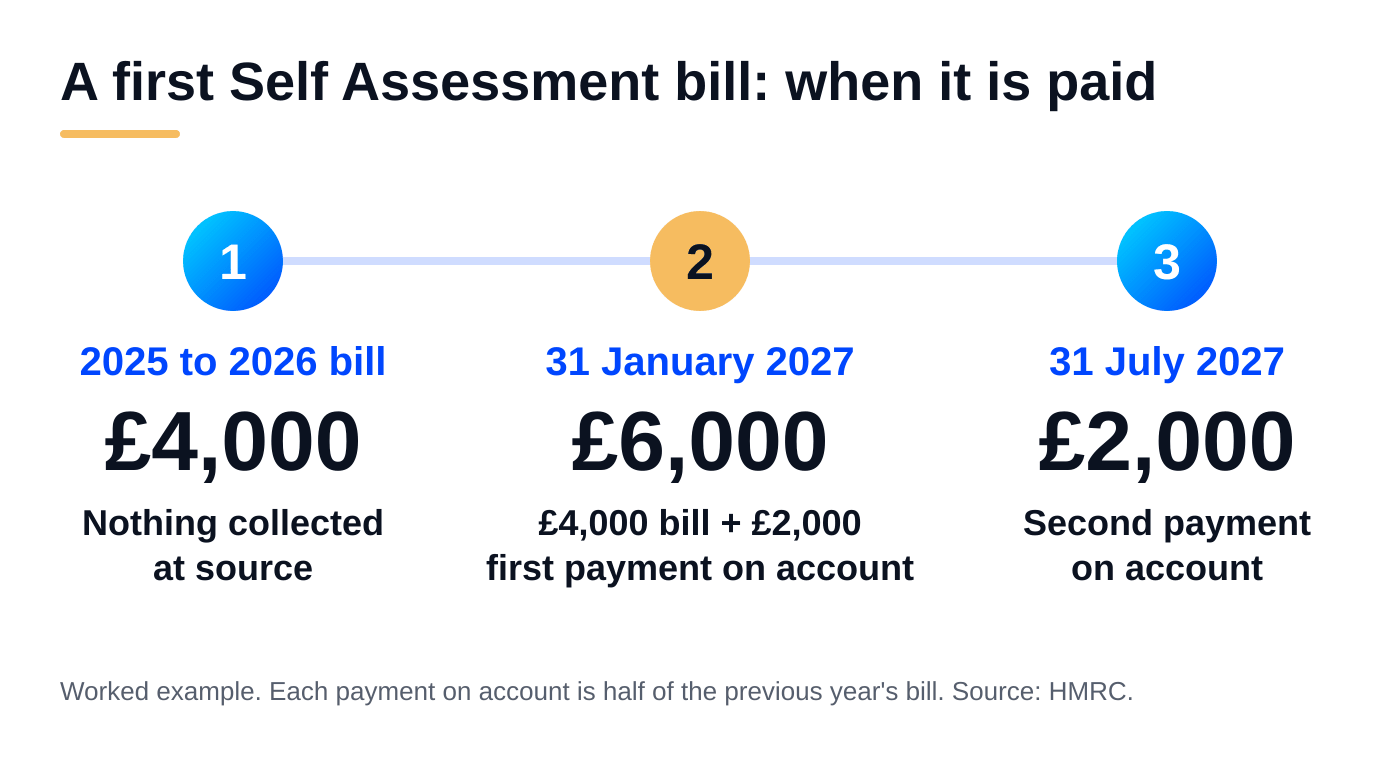
Unless last year’s bill was under £1,000, or more than 80% of your tax was already collected at source, for example through PAYE, HMRC asks for two advance payments towards next year’s bill. Each is half of your previous year’s bill, and they are due on 31 January and 31 July. So on 31 January 2027 you may pay your 2025 to 2026 balance plus the first payment on account for 2026 to 2027, with the second payment on account following on 31 July 2027. Our guide to how payments on account work goes through the detail, and gov.uk has the official version.
Here is Dan, a full-time eBay reseller with no job, filing for the first time. His 2025 to 2026 bill is £4,000, and no tax was collected at source. On 31 January 2027 he pays £6,000: the £4,000 bill plus a first payment on account of £2,000 for 2026 to 2027. On 31 July 2027 he pays the second payment on account of £2,000.
That January figure surprises many first-time filers, and it is the reason we tell sellers to set money aside as the sales come in rather than waiting for the bill. If you expect next year’s bill to be lower, you can ask to reduce your payments on account online or with form SA303. If you reduce them and your bill turns out higher, you may have to pay interest on the difference. If your income genuinely has fallen, do not assume you are stuck with the full amounts.
Want January sorted before Christmas? Our FCCA-chartered team prepares Self Assessment returns for UK online sellers every day. Book a free 30-minute call and we will tell you what you owe and when.
Missed the 5 October registration deadline?
If you had income in the 2025 to 2026 tax year that means you need to file, you had to tell HMRC by 5 October 2026. Plenty of sellers only find out about the rule after it has passed, and TikTok Shop, eBay and Vinted sellers who first started selling during 2025 to 2026 commonly miss the registration deadline.
If you missed it, register now rather than waiting. HMRC can charge a penalty for telling them late, but that penalty is based on tax still unpaid after 31 January 2027, so filing and paying in full by the deadline limits the damage. You are far better off being late and settled than invisible. Our guide to how to register for Self Assessment as an online seller walks you through it step by step.
Late filing and late payment penalties
The penalties for missing the 31 January 2027 deadline are steep, and they stack up faster than most sellers expect. The full breakdown is on gov.uk, and here is how it works for this return.
You get £100 as soon as the return is late, even if you owe no tax or have already paid everything you owe. After 3 months you also pay £10 a day for up to 90 days, up to £900, on top of the £100. After 6 months, you pay 5% of the tax due or £300, whichever is greater. After 12 months, another 5% or £300, whichever is greater, on top.
To be clear about how blunt that £100 is: someone who owes no tax at all and files on 3 February 2027 still gets the £100 penalty.
On top of filing penalties, late payment brings penalties of 5% of the unpaid tax at 30 days, again at 6 months and again at 12 months, plus interest. HMRC’s late payment interest rate is the Bank of England base rate plus 4 percentage points, and it rises to 8% from 24 November 2026. One point of calm: the new points-based penalty system does not apply to the 2025 to 2026 return, so the current penalties above are the ones that matter for it.
What to do now
You have got the dates, so here is the plan we would follow between now and the end of January.
- Check whether you need to file. If your sales before costs went over £1,000 for 2025 to 2026, or HMRC has asked you to file, you do.
- Register now if you missed 5 October. Late beats invisible, and settling by 31 January limits any late-notification penalty.
- Download your platform reports for 6 April 2025 to 5 April 2026. Sales, fees, postage and stock costs, in one folder.
- File online by 30 December 2026 if you owe less than £3,000 and pay tax through PAYE, so it can be collected through your tax code.
- Set money aside for 31 January 2027, including any first payment on account, not just the balance.
If you cannot pay in full when the bill lands, you can ask HMRC for a payment plan, known as Time to Pay, and spreading the cost is usually better than ignoring the bill and letting penalties stack.
Self Assessment deadline FAQs
When is the Self Assessment deadline for online sellers?
The deadline to file online and pay any tax owed for the 2025 to 2026 tax year is 31 January 2027. The paper deadline of 31 October 2026 has already passed. If you owe less than £3,000 and pay tax through PAYE, filing online by 30 December 2026 lets HMRC collect the tax through your tax code instead.
Do I need to file if I only sell on Vinted or eBay?
Selling your own unwanted belongings is not normally trading, so that alone does not mean you need to file. But if you buy or make things to sell for a profit and your sales before costs went over £1,000 in 2025 to 2026, you generally need to file a return. Platforms report sellers’ details and sales to HMRC, but being reported does not automatically mean you owe tax.
What happens if I miss the 31 January deadline?
You get a £100 penalty as soon as the return is late, even if you owe no tax or have paid everything you owe. After 3 months, you also pay £10 a day for up to 90 days, up to £900, on top of the £100, then further percentage penalties after 6 and 12 months. Late payment adds 5% penalties at 30 days, 6 months and 12 months, plus interest.
Can I still file a paper return for 2025 to 2026?
You can still send one, but the paper deadline was 31 October 2026, so it would be late and trigger the £100 penalty. Filing online by 31 January 2027 is on time, and any tax owed for 2025 to 2026 is also due by that date.
Does the £3,000 trading allowance apply to this return?
No. The trading allowance is £1,000 for the 2025 to 2026 tax year, measured on your gross sales before costs. The Autumn Budget on 28 October 2026 announced it rises to £3,000 from 6 April 2027, which is the 2027 to 2028 tax year, subject to legislation. It does not change anything for the return due on 31 January 2027.
Talk to a UK ecommerce accountant
If you’d like a hand applying any of this to your business, our FCCA-chartered team works with over 700 UK ecommerce sellers across Amazon, Shopify, eBay and TikTok Shop. Tell us about your store and we’ll show you exactly what we’d do. Book a free consultation or request a tailored quote.