VAT on discounts and vouchers: a Black Friday guide for UK online sellers
October 1, 2026
If Black Friday pushes you over the VAT threshold, you must tell HMRC within 30 days of the month end, and VAT applies from the first day of the second month after you went over, even if you never charged it. The threshold is measured over a rolling 12 months, so one peak month can push that total past £90,000.
Plenty of sellers sit below the threshold in October and are over it by the end of November. This guide covers the rolling 12-month test, a worked example with real deadlines, and what registering does to prices and margins. We run these checks for sellers every autumn.
- Why Black Friday tips sellers over the VAT threshold
- A worked example: from £78,000 to over £90,000 in one month
- What registering means for your prices and margins
- If the spike was a one-off: exception from registration
- What happens if you miss it
- A pre-peak checklist
- Frequently asked questions
Why Black Friday tips sellers over the VAT threshold
The registration test is not based on the tax year or calendar year. At each month end, add up taxable turnover for the previous 12 months. If that rolling total exceeds £90,000, tell HMRC within 30 days of that month end; registration takes effect from the first day of the second month after the month you went over. The threshold is unchanged for 2026/27.
Taxable turnover is the total value of taxable sales, including zero-rated sales, not profit. Zero-rated exports from the UK count, but sales of goods held and sold outside the UK, and sales of business assets, do not. For an online seller, that is gross sales across every channel: your own site plus every marketplace, before fees. Exempt sales do not count, but most ecommerce sellers have few or none. Our guide to how the VAT threshold works across channels covers the detail.
Q4 is the danger zone because each month an old month drops out of the rolling total and the new one comes in. The total moves by the difference between the month that drops out and the month that comes in, so if last November was quiet and this November is huge, a small month out and a big month in produces a large jump. A seller can look safe at the end of October and be over the line by the end of November, with Black Friday and Cyber Monday doing most of the pushing.
A second test matters less often. If you expect taxable turnover in the next 30-day period alone to exceed £90,000, you must register by the end of that period, with effect from the date you realised. This applies at any time, and is relevant if one very large wholesale order would on its own exceed the threshold. HMRC’s page on when to register sets out both tests.

A worked example: from £78,000 to over £90,000 in one month
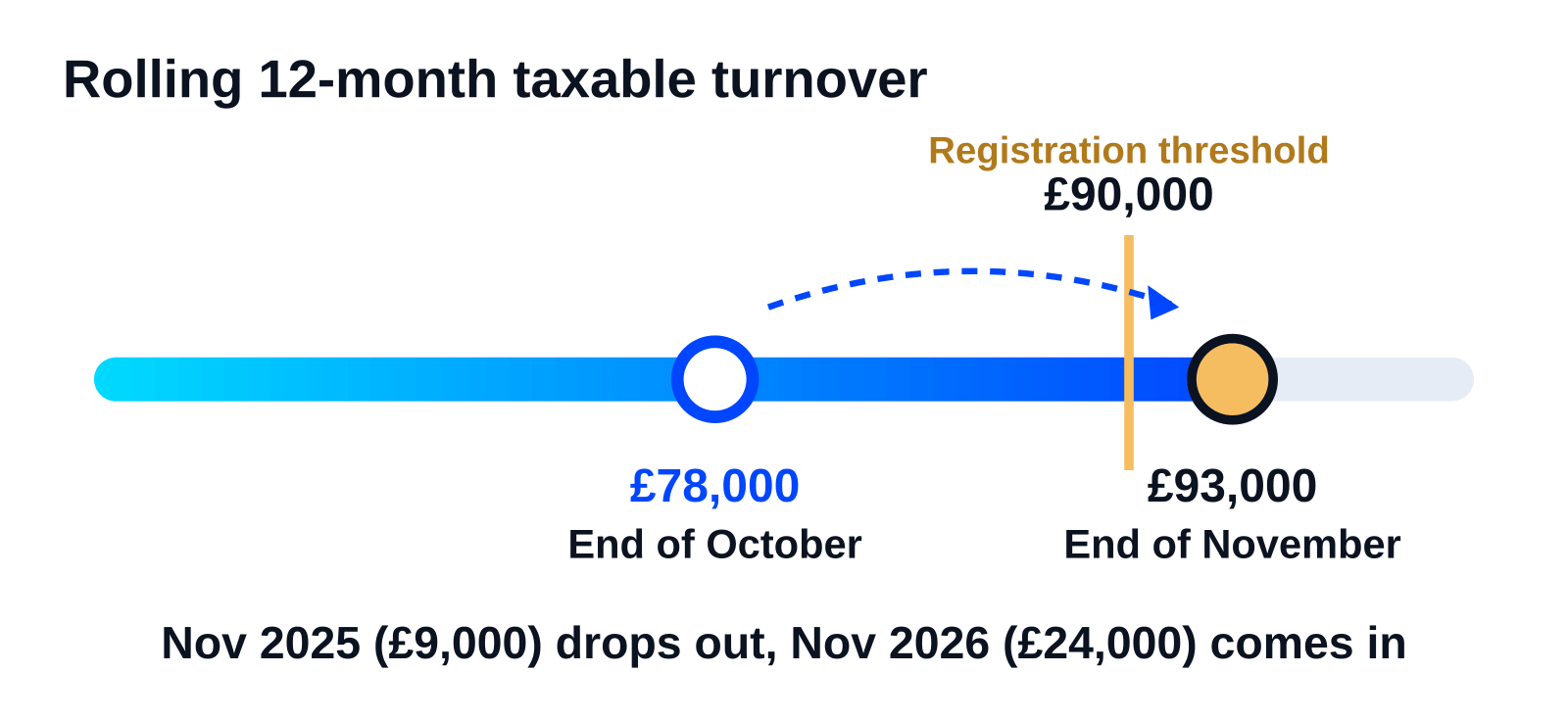
Take a Shopify and Amazon seller. Their rolling 12-month taxable turnover at the end of October 2026, covering November 2025 to October 2026, is £78,000. That looks comfortable. Their November 2025 sales were £9,000, a quiet month with no promotion behind it.
Then November 2026 arrives. Black Friday lands on 27 November and Cyber Monday on 30 November, and the month comes in at £24,000. The rolling total at the end of November 2026, covering December 2025 to November 2026, is £78,000 minus £9,000 plus £24,000, which is £93,000. That is over £90,000.
| Month-end | Rolling 12-month total | Over £90,000? |
|---|---|---|
| 31 October 2026 | £78,000 | No |
| 30 November 2026 | £93,000 | Yes |
From there the deadlines follow mechanically. They must tell HMRC by 30 December 2026, 30 days after the end of November. Registration takes effect from 1 January 2027, the first day of the second month after the month they went over. Once you are over at the November month end, later months cannot reverse the obligation.
The trap is the October month-end check. At £78,000 the seller relaxes; nothing in that number suggests danger. Checking only once, in October, gives no warning that Black Friday is about to tip them over. That is why the check belongs at every month end all year, with extra care through Q4. If you are planning promotions, our Black Friday cash flow forecast sits well alongside this.
What registering means for your prices and margins
From 1 January 2027 in our example, every sale carries VAT. What you do about prices is better decided in December than discovered in January. Take a product you sell to consumers for £24. If you keep the price at £24, that price now includes VAT, so £4 of it is VAT and you keep £20, a one-sixth hit to gross revenue unless prices go up.
Raising prices mid-peak-season is harder than it sounds. Marketplace prices are compared against competitors automatically, and a 20% rise on the shelf price can cost you the buy box or your search position. Across Amazon, eBay, Etsy and TikTok Shop as well as your own site, the decision needs to be made per channel, because repricing rules and fee structures differ. Sellers who absorb the VAT in January often plan a price rise for the spring.
Registration is not all outgoing. You can reclaim VAT on stock you still hold at registration, going back up to 4 years, provided you keep a stock account and the goods were not completely used up before registration. Services from up to 6 months before registration can also be reclaimed. For a seller sitting on Q4 inventory, that reclaim can offset the first VAT return. HMRC’s VAT Notice 700 covers the conditions.
Registration below the threshold is voluntary. Some sellers close to the line with large VAT-able costs register early, because the stock reclaim and the ability to charge VAT to business customers outweigh the admin. If your promotions include sitewide discounts, read our guide to VAT on Black Friday discounts and vouchers before setting the codes live, because discounted sales still count towards the threshold at the amount you actually charge.
Need this done for you? Our FCCA-chartered team handles VAT threshold checks for UK ecommerce sellers every day. Book a free 30-minute call and we’ll show you what we’d do in the first 30 days.
If the spike was a one-off: exception from registration
Going over £90,000 does not always mean registering. There is an exception, but it is not designed for Black Friday. Black Friday recurs every year, so a normal seasonal peak will usually reappear in the next 12 months and fail the £88,000 test. The exception is for a genuinely temporary spike, such as a one-off clearance of discontinued stock or a single product that went viral and has faded. If at a month end you have gone over £90,000 in the last 12 months but can show HMRC that your taxable turnover in the next 12 months will not go over £88,000, the deregistration threshold, you can apply for exception from registration.
In our example, suppose the £24,000 November was boosted by a one-off cause that will not repeat next November, such as a clearance of discontinued stock or a product that went viral for two weeks and has faded. If the seller can show the next 12 months from December 2026 will bring in no more than £88,000, they can apply for the exception instead of registering. The application needs a full explanation and a realistic forecast of why the spike was one-off.
Timing matters. Apply early using form VAT1 together with VAT5EXC, with the explanation and forecast ready rather than waiting to see. If HMRC grants the exception it is not permanent, so keep checking your rolling total every month and register if you go over again. If HMRC refuses, you are registered from the original date, back in the late-registration position with VAT due on sales where you never charged it. HMRC sets out the exception rules in VAT Notice 700/1.
Be honest about the forecast. If Black Friday is the new normal, because your range has grown or ad spend has scaled, the exception is the wrong route and the forecast will not survive scrutiny. It exists for genuine spikes, not turnover that has simply stepped up a level. This is one of the judgements our ecommerce accounting services help sellers make each autumn.
What happens if you miss it
Peak season is busy, and the most common way sellers miss the threshold is not looking until the January bookkeeping catch-up. The obligation does not wait for you to notice: VAT is due from the date you should have been registered, even on sales where you did not charge VAT.
Because you did not add VAT to your prices, HMRC treats the price charged as including VAT. At the 20% standard rate, the VAT is one sixth of the gross. If the seller in our example misses the 30 December 2026 deadline and notices in late January, VAT is still due from 1 January 2027 on everything sold since, plus a possible penalty.
That penalty is separate from the VAT. HMRC’s factsheet CC/FS11 sets out failure-to-notify penalties as a percentage of the VAT owed, the potential lost revenue. For a non-deliberate failure you disclose yourself within 12 months, the range is 0% to 30%. If HMRC finds it first, or you are more than 12 months late, the minimum rises. Deliberate failures can reach 70%, and deliberate and concealed failures 100%.
The message is straightforward: telling HMRC yourself, early, is by far the cheapest way through a mistake. A seller who tips over because of Black Friday and tells HMRC by the deadline pays the VAT and no failure-to-notify penalty. The same seller who waits for the January catch-up pays the same VAT, a penalty, and has a much harder conversation.
A pre-peak checklist
- Run your rolling 12-month total now, across every channel: your own site plus every marketplace, gross sales before fees.
- Forecast November and December using last year’s figures plus this year’s growth, and see which month-end could tip you over £90,000.
- Mark that month-end on your calendar and check the rolling total again that day.
- Decide on pricing in advance: absorb the VAT, pass it on, or phase a price rise, before 1 January rather than after.
- Set a reminder for every month end, because the rolling total keeps moving all year.
- Talk to us if any numbers look close, so the deadlines and the exception route are handled properly.
Frequently asked questions
Is the VAT threshold based on the tax year or a rolling 12 months?
A rolling 12 months. At the end of every month you add up taxable turnover for the previous 12 months, and if it is over £90,000 you must tell HMRC within 30 days of that month end. Registration takes effect from the first day of the second month after the month you went over. Neither the tax year nor the calendar year is relevant.
Do Amazon and eBay sales count towards my VAT threshold?
Yes, sales of goods you hold in the UK count, whichever marketplace you sell through, added to every other channel, gross and before fees. Where the marketplace is treated as the seller for VAT, for example goods sent from overseas in consignments of £135 or less, or goods sold by sellers not established in the UK, the marketplace accounts for the VAT and those sales are treated differently, so check before counting them.
What if I only went over the VAT threshold because of Black Friday?
You may be able to apply for exception from registration, but only if the spike was genuinely one-off. Black Friday recurs every year, so a predictable seasonal peak will usually fail the £88,000 test. If you can show HMRC that your taxable turnover in the next 12 months will not go over £88,000, the deregistration threshold, you can ask for an exception. Apply early using form VAT1 together with VAT5EXC, with a full explanation and a realistic forecast. If HMRC refuses, you are registered from the date you should have been.
Do I have to pay VAT on sales I made before I registered?
VAT is due from the date you should have been registered, not when you actually registered. If you did not charge VAT on those sales, HMRC treats the price you charged as including VAT, so the amount due is one sixth of the gross at the 20% rate. A failure-to-notify penalty may also apply, ranging from 0% to 30% for a careless error you disclose yourself within 12 months.
Can I reclaim VAT on stock I bought before registering?
Yes, in the right conditions. You can reclaim VAT on goods such as stock bought up to 4 years before registration if you still hold them at registration, or they were used to make goods you still hold, and you keep a stock account. Services bought in the 6 months before registration can also be reclaimed. Goods completely used up before registration cannot be claimed.
Talk to a UK ecommerce accountant
If you’d like a hand applying any of this to your business, our FCCA-chartered team works with over 700 UK ecommerce sellers across Amazon, Shopify, eBay and TikTok Shop. Tell us about your store and we’ll show you exactly what we’d do. Book a free consultation or request a tailored quote.