WooCommerce or Shopify for UK Business: An Honest Look at Both
April 30, 2026
EU €3 Customs Duty 2026: What UK Sellers Will Pay
May 12, 2026
MTD for ecommerce sole traders went live on 6 April 2026, and the first quarterly deadline is now just three months away. If you sell on Shopify, Amazon, eBay or Etsy as a sole trader, the way you report your income to HMRC has fundamentally changed. This guide explains exactly what you need to do, the deadlines you cannot miss, and why online sellers face a tougher transition than most.
What is Making Tax Digital for Income Tax?
Making Tax Digital for Income Tax Self Assessment (MTD for ITSA) is HMRC’s new digital reporting regime. It replaces the once-a-year Self Assessment return with a continuous, software-based system. Under the new rules, you must keep digital records of every sale and expense, send HMRC a summary every three months, and file an annual final declaration after the tax year ends.
The change has been delayed several times since it was first announced, but as of 6 April 2026 it is now law for the first wave of UK taxpayers.
Who has to comply in 2026?
You are in the first wave of MTD if you are a UK sole trader or landlord whose qualifying income for the 2024/25 tax year was more than £50,000.
This is the point that catches most online sellers out: HMRC measures qualifying income on gross turnover, not profit. If your store turned over £55,000 in 2024/25 but you only kept £15,000 after stock, marketplace fees and ad spend, you are still legally required to join MTD now. The threshold then drops to £30,000 from April 2027, and to £20,000 from April 2028, so almost every active ecommerce sole trader will be in scope within three years.
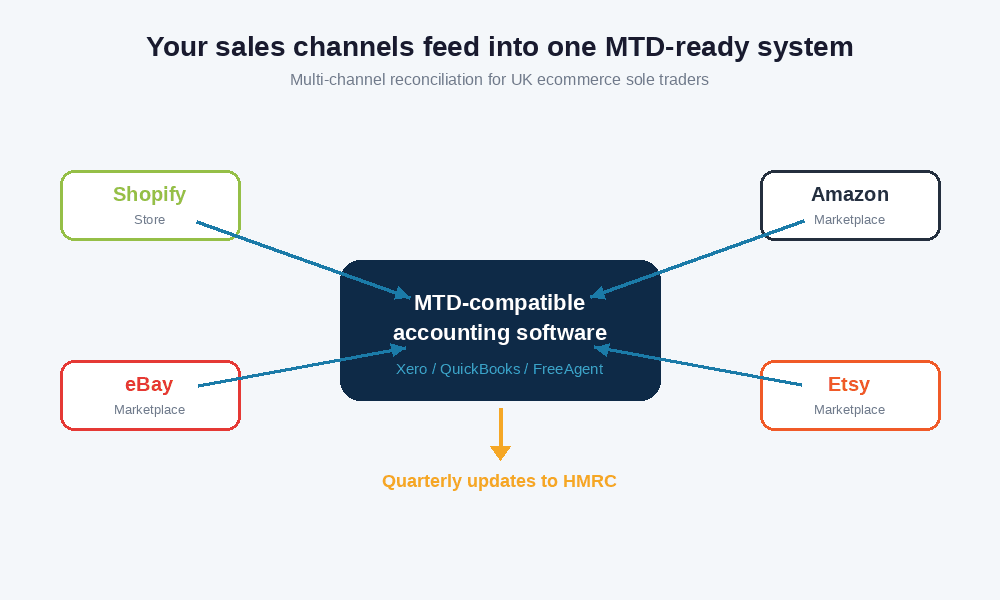
The four things MTD for ecommerce sole traders requires
- Keep digital records of every business transaction (sales, refunds, fees and expenses).
- Use MTD-compatible software such as Xero, QuickBooks Online, FreeAgent or Sage. Spreadsheets are only allowed if combined with bridging software.
- Submit four quarterly updates to HMRC, summarising income and expenses for each three-month period.
- Submit a final declaration after the tax year ends, which replaces your Self Assessment return.
Why MTD is harder for online sellers
Most sole traders have a handful of invoices a month. An ecommerce sole trader can have thousands of transactions, multi-channel payouts, marketplace fees, refunds, returns, foreign currency settlements and stock movements all flowing through several platforms at once. Manual record-keeping is no longer realistic, and even tidy spreadsheets struggle with the volume.
The most common mistakes we see ecommerce clients make are:
- Reporting Shopify or Amazon gross sales without netting off fees correctly.
- Missing refunds and chargebacks in the quarter they actually occurred.
- Forgetting to record cost of goods sold, which inflates taxable profit.
- Mixing personal and business transactions on PayPal, Stripe or Wise.
- Treating Amazon FBA reimbursements and inventory adjustments as income.
Each of these errors can quietly push a quarterly update out of line with reality, and once that happens, untangling it for the final declaration is painful.
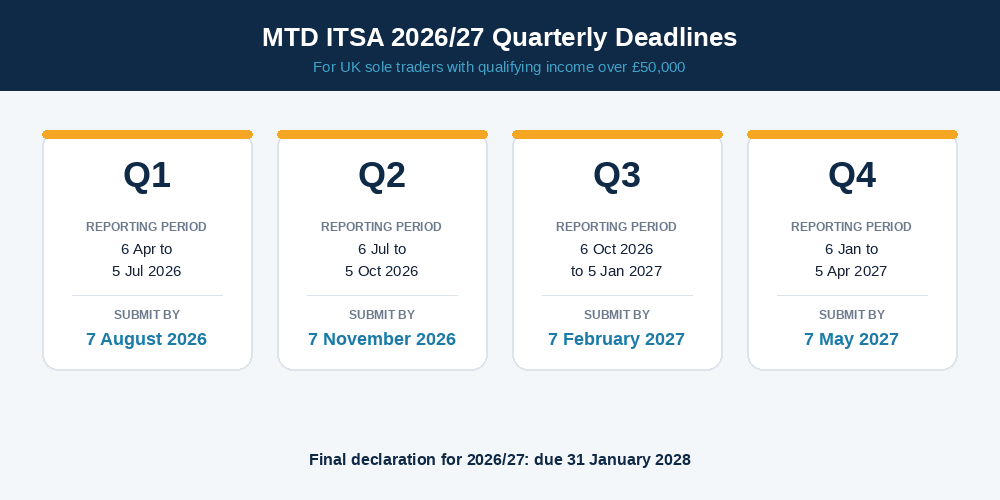
The 2026/27 deadlines you must hit
- Q1: 6 April to 5 July 2026, submission due 7 August 2026.
- Q2: 6 July to 5 October 2026, submission due 7 November 2026.
- Q3: 6 October 2026 to 5 January 2027, submission due 7 February 2027.
- Q4: 6 January to 5 April 2027, submission due 7 May 2027.
- Final declaration for 2026/27: due 31 January 2028.
HMRC has confirmed a soft landing for the first year, which means no penalty points for late quarterly submissions during 2026/27 if you are in the first cohort. That is helpful breathing room, but it is not an excuse to drift, since the late payment interest and final declaration penalties still apply.
A 5-step checklist to get ready
- Confirm your qualifying income (gross, not profit) was above £50,000 in 2024/25.
- Choose MTD-compatible software, ideally Xero, QuickBooks Online or FreeAgent.
- Connect your sales channels properly using a feed tool such as A2X or Link My Books, so Shopify and Amazon payouts reconcile cleanly.
- Set up a chart of accounts that separates fees, refunds, ad spend, COGS and shipping income.
- Reconcile every month, so the quarterly submission becomes a five-minute review rather than a frantic catch-up.
How Sync Accountants can help with MTD for ecommerce sole traders
At Sync Accountants we specialise in helping UK ecommerce sole traders set up and run Making Tax Digital for Income Tax without the stress. We handle the software setup, channel integrations, monthly bookkeeping, quarterly submissions and final declaration, all wrapped into one fixed monthly fee.
If your business turned over more than £50,000 last year, do not wait until July to start. Get in touch today for a free MTD readiness call and we will get your records, software and quarterly schedule sorted before the first deadline lands.