
VAT Threshold and Black Friday: What Happens If Q4 Tips You Over £90,000
October 8, 2026
Universal Credit self-employed payments are usually worked out on what you actually receive and pay out in each monthly assessment period. One big Black Friday month can stop your payment, and if your earnings are £2,500 or more over the limit, the surplus earnings rule carries the excess into the next month.
This is for UK online sellers on Amazon, eBay, Etsy, Shopify, TikTok Shop or Vinted who claim Universal Credit. You’ll learn how monthly reporting works, what a Black Friday spike does to your payments, and how a loss in one month can soften the next. We run these checks for sellers as part of our ecommerce accounting services.
- How Universal Credit counts self-employed income
- What a Black Friday spike does: the surplus earnings rule
- Universal Credit self-employed worked example: October to January
- The Minimum Income Floor and seasonal sellers
- How to prepare before Black Friday
- Frequently asked questions
How Universal Credit counts self-employed income
If you are self-employed and claim Universal Credit, you report your business income and expenses once a month through your online account, for each monthly assessment period. This applies even if you had no income or expenses that month, and even if DWP does not class you as gainfully self-employed. DWP sends a text or email when it is time to report.
Reporting on time matters. As gov.uk puts it, “You will not get your Universal Credit payment until you have reported your business income and expenses. If you report late, your payment may be delayed.” For an ecommerce seller, income means everything you were paid in the assessment period, no matter when you did the work to earn it. Marketplace payouts count in the period the money reaches you, not when the orders were placed.
Expenses work the same way. You report the allowable expenses the business paid out during the assessment period, provided they are wholly, exclusively and reasonably for the business. Stock and goods for resale are allowable expenses, which is why a month spent buying stock can look very different from a month when the payouts arrive. For more on what DWP can and cannot see about your sales, see our guide to what the DWP can see about your marketplace sales. DWP’s guidance on reporting self-employed earnings sets out the detail.
Once your earnings are counted, the taper applies: for every £1 of earnings, Universal Credit goes down by 55p. If you are responsible for a child, or you have a health condition or disability affecting your ability to work, a work allowance applies first (£427 a month if you get help with housing costs, £710 if not), so only earnings above that taper.
Trading or selling unwanted items?
gov.uk is clear that selling regularly to make a profit, selling online regularly, or making goods to sell counts as trading, and that if you trade on online platforms such as eBay or Vinted, you must report this income. Selling unwanted personal belongings occasionally is different: that money is treated as capital and counts towards the savings limits, reported as a change of circumstances in the money, savings and investments section. If you’re unsure where the line sits, our guide to tax on selling old items online covers the tax side.

What a Black Friday spike does: the surplus earnings rule
Here is where a Universal Credit self-employed claim gets seasonal. If your earnings in an assessment period are so high that you get no Universal Credit at all, and they are £2,500 or more over the limit at which Universal Credit stops, the amount over £2,500 is carried into the next assessment period and counted as earnings again if your claim continues or restarts. gov.uk calls this “surplus earnings”.
The timing is what catches sellers out. Black Friday 2026 falls on Friday 27 November and Cyber Monday on 30 November, so payouts from that weekend may land in late November or in the following assessment period, depending on when the money reaches you. This is why assessment period dates matter before the peak: which month the money counts in is decided by when you receive it, not by when the orders were placed.
If a surplus pushes you out of Universal Credit, there is a safety net. gov.uk says that if your earnings drop enough for you to be eligible again within 5 months, your payment restarts automatically, and after that you need to apply again. The regulations refer to 6 months for surplus earnings, so a surplus can still count on a new claim made shortly after that, and it is worth checking with DWP if you reclaim. gov.uk’s surplus earnings guidance explains the mechanics.
One wrinkle worth knowing: the £2,500 figure is temporary. A determination signed on 20 January 2026 extended it to 31 March 2027, but the permanent figure in the regulations is £300. Whether it is extended again has not been announced, and the Autumn Budget on 28 October 2026 may say more. If it reverts to £300, much smaller spikes will start carrying over into following months.
Universal Credit self-employed worked example: October to January
Take a single claimant aged 25 or over, with no children, no housing costs and no health condition, so no work allowance. They are still in their start-up period, so the Minimum Income Floor does not apply, and they are not VAT registered. Figures assume no tax or National Insurance is paid to HMRC during these four months. The standard allowance is £424.90 a month, so Universal Credit stops when earnings reach about £772.55 a month (£424.90 divided by 0.55).
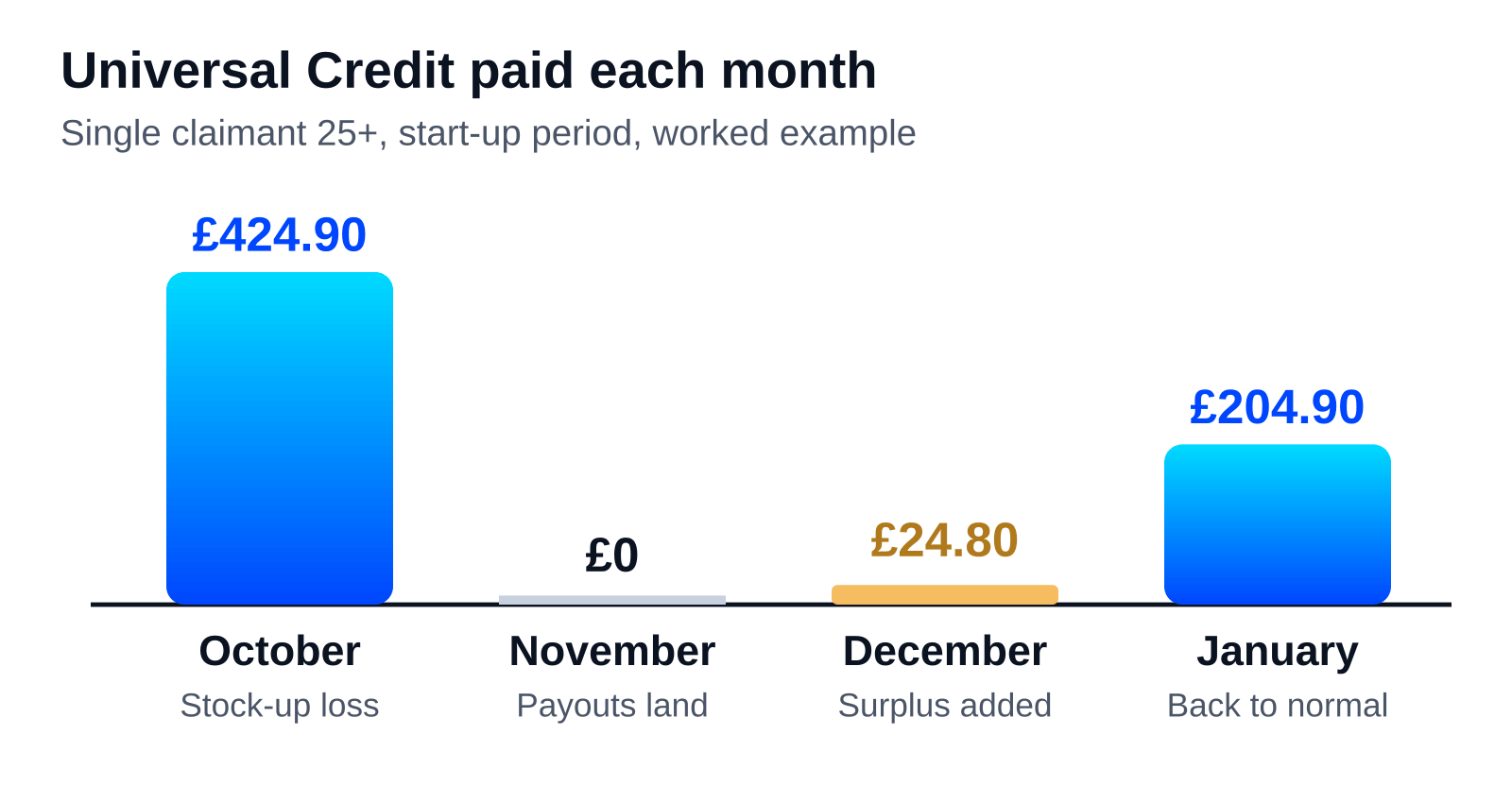
In October they stock up for the peak: money in £1,500, money out £2,700, mostly stock. That is a £1,200 loss, carried forward and deducted from later earnings. Earnings counted: £0. Universal Credit: £424.90.
| Month | Money in | Money out | Earnings counted | Universal Credit |
|---|---|---|---|---|
| October | £1,500 | £2,700 | £0 | £424.90 |
| November | £7,000 | £2,200 | £3,600 | £0 |
| December | £1,500 | £1,100 | £727.45 | £24.80 |
| January | £1,500 | £1,100 | £400 | £204.90 |
November is when the Black Friday payouts land: money in £7,000, money out £2,200, so £4,800 profit. Minus the £1,200 unused loss from October, £3,600 is counted. That is £2,827.45 over the £772.55 limit, so no Universal Credit, and £327.45, the amount over £2,500, carries into December as surplus earnings.
In December, money in £1,500 and money out £1,100 leave £400 profit, plus the £327.45 surplus, so £727.45 counted. Universal Credit is £24.80, which is £424.90 minus 55% of £727.45. In January, profit is £400 with nothing carried over, and the payment is £204.90.
For comparison, a seller with the same November but no earlier loss to carry forward would be in a different position: November would count £4,800, the surplus would be £1,527.45, December would count £1,927.45, and December’s payment would be nil instead of £24.80. The loss only exists because the stock was paid for in October, and the rules simply count each payment in the period it happened.
The £2,500 level covers this November. If the same figures happened after it lapsed and the £300 figure applied, £2,527.45 would carry into December (£2,827.45 minus £300), wiping out that payment, and some of it could roll into later months too. The rules ask you to report what actually came in and went out in each period, nothing more and nothing less. This is a single illustration, and your own figures will depend on your circumstances.
Need this done for you? Our FCCA-chartered team keeps monthly records for self-employed UK ecommerce sellers every day, including sellers who claim Universal Credit. Book a free 30-minute call and we’ll show you what we’d do in the first 30 days.
The Minimum Income Floor and seasonal sellers
One more rule shapes all of this for the Universal Credit self-employed: the Minimum Income Floor. Once DWP decides you are “gainfully self-employed”, meaning self-employment is your main job, it is organised, developed and regular, and you do it expecting a profit, the MIF can apply. It is the amount an employed person in a similar situation would earn on the National Living Wage or National Minimum Wage, after tax and National Insurance, based on the hours you are expected to work. The National Living Wage is £12.71 an hour from April 2026 for those aged 21 and over, per the official rates. If your actual earnings are below the MIF, DWP uses the MIF figure instead.
Newly gainfully self-employed claimants get a start-up period of up to 12 months, as long as they are taking active steps to increase their earnings. DWP can end it early. You generally cannot get another one unless the last one started more than 5 years ago, for a different business that you have since stopped. gov.uk’s quick guide to Universal Credit and self-employment covers the conditions.
For a seasonal seller, the pattern is unkind in both directions. After the start-up period, a quiet summer month below the MIF is counted at the MIF figure, not your actual earnings, while a busy November counts actual earnings and can trigger the surplus earnings rule. Peaks and troughs each cost you something, which is why knowing which side of the start-up period you are on matters before Black Friday.
How to prepare before Black Friday
Most of the surprises in the worked example come from the timing rules, so accurate monthly records help you see them coming. Here is what sellers commonly put in place before the peak.
- Know your assessment period dates, so you can tell which month each payout will land in.
- Record payouts in the period the money is received, not when the orders were placed.
- Record stock purchases in the period they were paid, and keep the receipts.
- Keep track of unused losses, so they are deducted from later earnings, oldest first.
- Set money aside for the months after a big peak, because a surplus can carry into the next assessment period. Our Black Friday cash flow forecasting guide helps here.
- Report every month on time, even a nil month, so payments are not delayed.
A big peak can affect your VAT position too, so read our guide to the Black Friday VAT threshold alongside this one.
Frequently asked questions
Do I have to report eBay or Vinted sales to Universal Credit?
Yes, if you are trading rather than clearing out. gov.uk says that selling regularly to make a profit, selling online regularly, or making goods to sell counts as trading, and that if you trade on online platforms such as eBay or Vinted you must report this income. Selling unwanted personal belongings occasionally is not trading: that money is treated as capital and counts towards the savings limits, reported as a change of circumstances.
What are surplus earnings on Universal Credit?
If your earnings are £2,500 or more over the limit at which Universal Credit stops, the amount over £2,500 is carried into the next assessment period and counted as earnings again if your claim continues or restarts. gov.uk says if your earnings drop enough to be eligible again within 5 months, your payment restarts automatically, and after that you apply again. The regulations refer to 6 months, so a surplus can still count on a new claim made after the 5 months, and it is worth checking with DWP if you reclaim.
Does the £2,500 surplus earnings limit end in 2027?
The £2,500 figure is a temporary level. A determination signed on 20 January 2026 extended it to 31 March 2027, and the permanent figure in the regulations is £300. Whether it will be extended again has not been announced, so watch the Autumn Budget on 28 October 2026. If it reverts to £300, much smaller spikes will start carrying over into following assessment periods.
Can a loss in one month reduce my Universal Credit earnings later?
Yes. If your business expenses are more than your income in an assessment period, the loss is carried forward and deducted from later earnings, oldest first, until it is used up. In our worked example, a £1,200 October loss from stocking up reduced the November earnings counted from £4,800 to £3,600, which in turn reduced the surplus carried into December.
Does the Minimum Income Floor apply to new online sellers?
Usually not during the start-up period. If DWP decides you are gainfully self-employed, you get a start-up period of up to 12 months, as long as you are taking active steps to increase your earnings. DWP can end it early. After that, if your actual earnings in a month are below the MIF, DWP uses the MIF figure instead, which is based on National Living Wage earnings for your expected hours. You generally cannot get another start-up period unless the last one started more than 5 years ago, for a different business that you have since stopped.
Talk to a UK ecommerce accountant
If you’d like a hand applying any of this to your business, our FCCA-chartered team works with over 700 UK ecommerce sellers across Amazon, Shopify, eBay and TikTok Shop. Tell us about your store and we’ll show you exactly what we’d do. Book a free consultation or request a tailored quote.