
Marketplace VAT Traps: Read This Before HMRC Does
March 13, 2026
Can You Trust AI With Your Accounting
April 21, 2026
Understanding the Amazon auto reporting DWP framework is crucial for e-commerce sellers who also claim Universal Credit or other government benefits. With digital platform tax rules firmly established in 2026, many online business owners are understandably anxious about their financial privacy. A common fear is that the Department for Work and Pensions (DWP) now possesses a direct, automated feed monitoring every single sale made and every item bought.
However, media coverage often blends proposed government powers, phased rollouts, and automated verification into exaggerated claims. As accounting professionals, we want to gently correct the record. Let us break down exactly what information is shared, the true scope of the DWP’s bank monitoring, and what this actually means for your e-commerce business.
How the Amazon Auto Reporting DWP Connection Actually Works
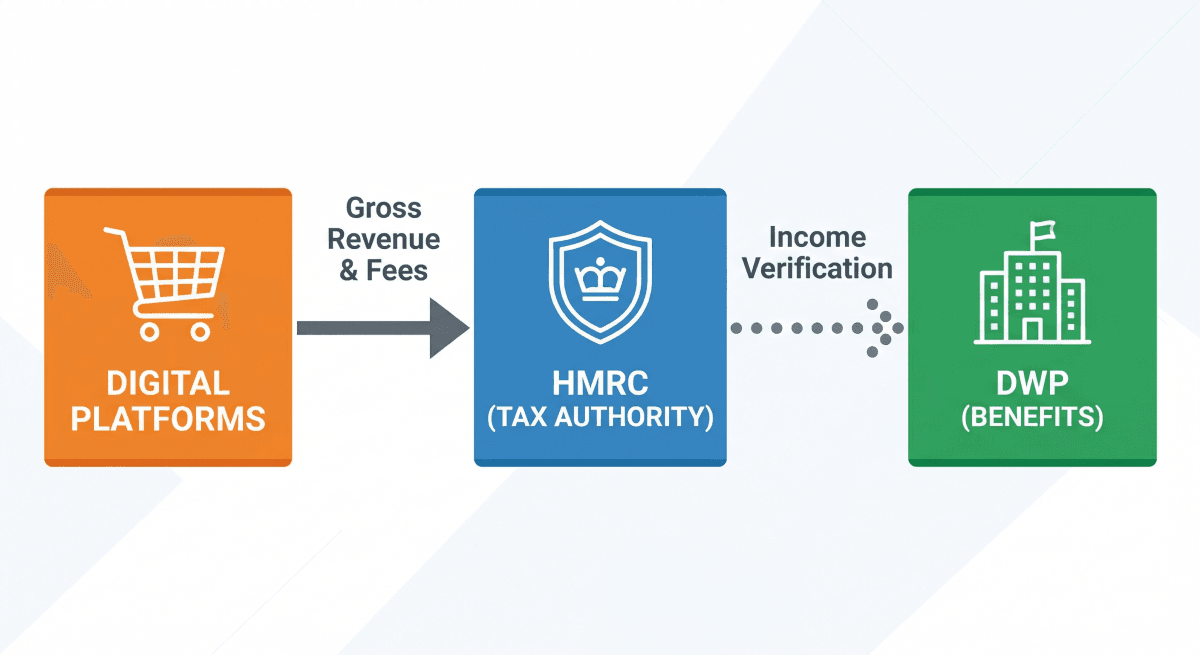
The foundation of the Amazon auto reporting DWP concern stems from the international digital platform reporting rules that became UK law a few years ago. Under these regulations, online marketplaces like Amazon, eBay, and Vinted are legally required to report seller income data directly to HM Revenue & Customs (HMRC).
Amazon sends HMRC your gross revenue, the platform fees you paid, and your linked bank account details. HMRC then processes this information through its advanced “Connect” analytics system. Because HMRC and the DWP have formal data-sharing agreements designed to ensure claimants are accurately declaring self-employed earnings, the DWP can access this relevant data.
If the monthly income you declare for Universal Credit significantly mismatches the annual sales data HMRC holds, your benefit claim may be flagged for a standard compliance review. It is an income-verification tool, not an all-seeing eye.
Do HMRC or the DWP Automatically See Your Spending?
A major misconception regarding the Amazon auto reporting DWP data flow is that it gives the government an automated, itemized list of your business expenses or personal shopping habits. This is entirely false.
Amazon only reports the fees you pay within its own ecosystem (such as FBA fulfillment or referral fees). It does not—and cannot—report your off-platform business expenses, such as purchasing wholesale inventory, shipping supplies, or paying for warehouse rent. Furthermore, neither HMRC nor the DWP receives a routine, automated feed of your everyday outgoing transactions. Your daily consumer choices remain private.
Clarifying the 2026 DWP Bank Monitoring Powers
Recent headlines about the DWP’s enhanced bank-monitoring powers have caused widespread panic, but it is important to understand their exact legal and operational scope. Under the “Eligibility Verification” measures, the DWP can require banks to provide information to help verify benefit entitlement.
However, this is not an automatic monitoring of millions of accounts where every purchase is scrutinized. Instead, banks are asked to flag accounts that show clear, high-level indicators of ineligibility—such as savings exceeding the £16,000 capital limit or regular, undeclared income deposits. Banks do not forward your daily Amazon purchases or routine business spending to the government.
The primary time the DWP will see your specific outgoing transactions is during a manual claim review, where you may be asked to provide bank statements. Even in these specific checks, assessors are looking for undeclared capital, hidden income, or “deprivation of capital” (deliberately spending away savings to qualify for benefits). They are not there to judge reasonable, everyday spending.
Protecting Your E-commerce Business
Because the Amazon auto reporting DWP pipeline only provides the government with your gross sales figures and platform fees, it is entirely up to you to track and report your allowable business expenses.
If the DWP queries your self-employed income based on HMRC’s data, they will be looking at your gross revenue. If you have not meticulously recorded your off-platform expenses, your gross income could be mistakenly treated as pure profit. This could unfairly reduce your Universal Credit entitlement.
Conclusion
Ultimately, the Amazon auto reporting DWP landscape is designed to verify declared income and prevent benefit fraud, not to monitor your daily shopping habits or automatically scrutinize every business expense. While the government’s data-matching technology is sophisticated, transparency and accurate bookkeeping remain your best defense. By keeping precise records of your income and allowable expenses, you can run your e-commerce business confidently and stay fully compliant. If you need assistance navigating self-assessment or welfare reporting, consulting a professional accountant is a wise step.